
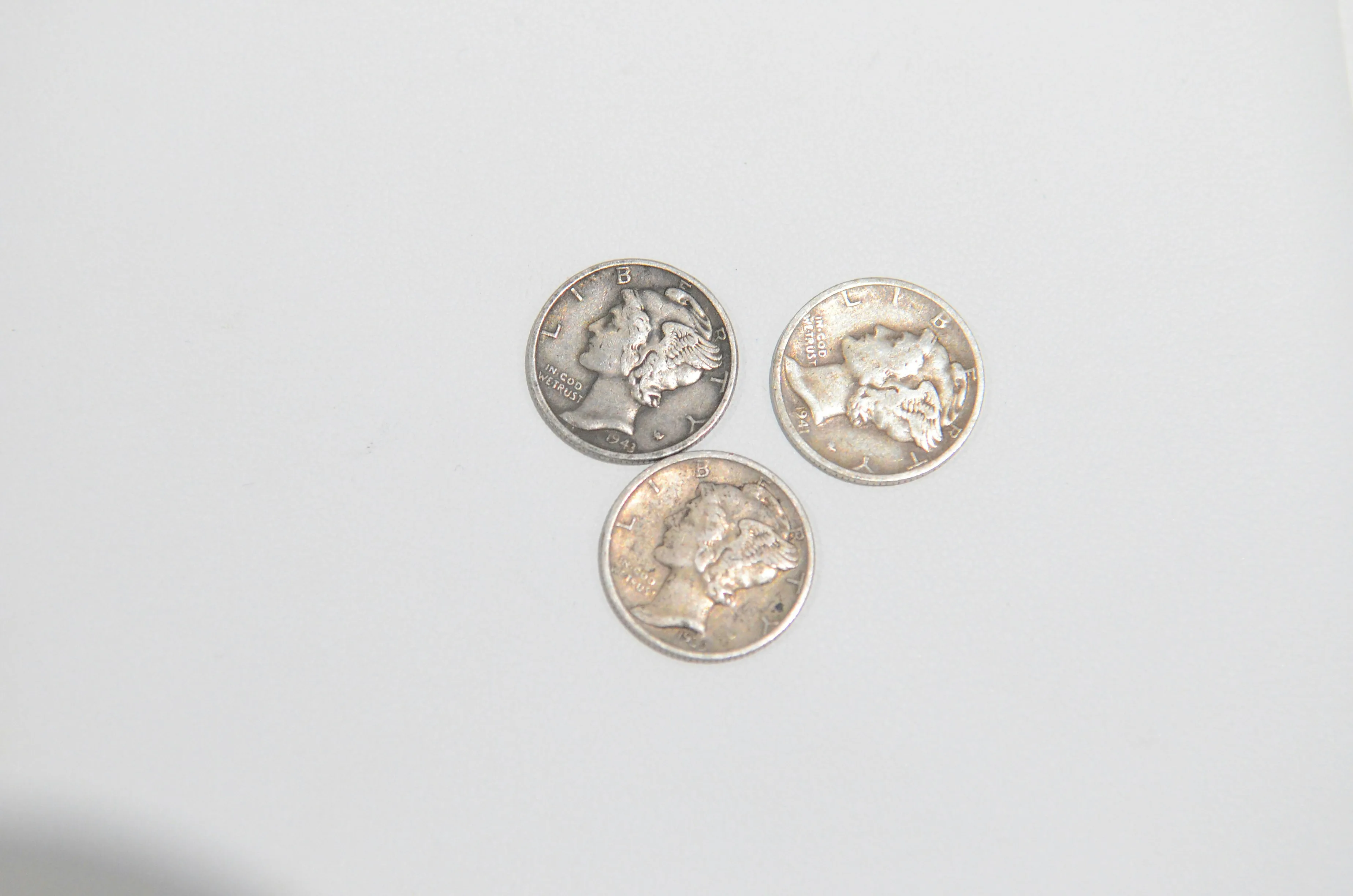
Constitutional silver
Constitutional Silver and Junk Silver: Terminology
The United States used silver coinage for daily commerce from 1792 until 1965. Today these coins trade in precious metals markets under two names: "Constitutional Silver" and "Junk Silver."
"Constitutional Silver" refers to the legal basis of these coins. Article I, Section 8, Clause 5 grants Congress power "to coin money, regulate the value thereof." The Coinage Act of 1792 established a bimetallic standard and tied the U.S. dollar to the Spanish milled silver dollar. For centuries, silver coins were "lawful money" backed by physical metal rather than bank promises. Investors prefer "Constitutional Silver" because it acknowledges this legal heritage.
"Junk Silver" is dealer slang. The word "junk" does not describe the metal (which is 90% pure) but rather the condition. These circulated coins carry no numismatic premium, only melt value. Because they lack rarity or pristine condition, their price tracks the spot price of silver exactly. This makes junk silver a liquid, divisible entry point for investors who want physical metal without paying high premiums for rare coins or modern bullion.
The Genesis of the American Silver Standard
The Coinage Act of 1792 created the United States Mint in Philadelphia. It replaced the chaotic mixture of British pounds, Spanish reales, and state-issued coppers with a decimal system. The Act defined exact weights and purities for gold, silver, and copper coins. Anyone with silver bullion could deposit it at the Mint for coinage at a small fee called "free coinage."
The Mint produced silver coins in designs that changed with the nation's aesthetic tastes. From 1796 through 1807, dimes, quarters, and half dollars all shared the Draped Bust design. Capped Bust followed from 1815 to 1838. Seated Liberty dominated from 1838 to 1891.
A bimetallic system created problems. When market silver-to-gold ratios diverged from the government's mint ratio, arbitrageurs hoarded or exported the undervalued metal. The government adjusted silver coin weights periodically, notably in 1834 and again with the Coinage Act of 1853, to keep coins circulating at home rather than flowing to melting pots abroad.
The "Crime of '73" and Bimetallic Politics
The bimetallic standard was destroyed by the government in the 1870s. The Fourth Coinage Act of 1873, called the "Crime of '73" by its opponents, dropped the statutory provision for free coinage of silver. The United States was now on a de facto gold standard to the dismay of those who wanted to keep silver as money. Silver was demonetized while gold coinage continued.
This hurt different regions differently. Farmers, miners, and agricultural interests in the South and West wanted silver's inflation to raise crop prices and relieve debt. Eastern bankers, railroads, and industrialists preferred gold's stability and international trade advantages.
Silver proponents organized for the metal's return. Congress compromised with the Bland-Allison Act of 1878 and the Sherman Silver Purchase Act of 1890, which forced the Treasury to buy massive quantities of domestic silver. During Bland-Allison's twelve years, the government absorbed over 60% of domestic silver production, generating roughly $68 million in seigniorage ($3 to $9 million annually). These forced purchases created macroeconomic imbalances. The Sherman Act is widely cited as a cause of the Panic of 1893.
In 1900, the United States formally abandoned bimetallism for a gold-only standard. Yet silver coins and silver-backed paper certificates remained in daily use until the mid-20th century.
Silver Certificates: Representative Money
Carrying heavy silver coins was impractical for large transactions. The government issued Silver Certificates between February 28, 1878 and March 1964. These paper notes had no intrinsic value but represented claims on silver dollars or bullion held in Treasury vaults. Unlike Federal Reserve Notes (which came later), Silver Certificates were printed directly by the Treasury's Bureau of Engraving and Printing.
Large-Size Certificates (1878–1923)
Early Silver Certificates were 1.5 inches longer and 0.5 inches wider than modern bills. Initially printed in denominations from $10 to $1,000, they functioned as Certificates of Deposit for silver dollars held at the Treasury. In 1886, Congress authorized $1, $2, and $5 notes. These large-size notes featured ornate artwork, including the 1899 $5 certificate depicting Húŋkpapȟa leader Running Antelope and the famous 1896 Educational Series.
Small-Size Certificates (1928–1964)
In 1928, the Treasury redesigned all banknotes to smaller dimensions to cut printing costs. The small-size Silver Certificate era featured primarily $1, $5, and $10 denominations. The first small-size notes released on July 10, 1929 were nicknamed "Funnybacks" for their unusually large, simplistic reverse lettering.
Collectors identify small-size Silver Certificates by their blue Treasury seals, blue serial numbers, and the words "Silver Certificate" across the top.
The 1934 Change
Series 1934 certificates carried altered wording: "This certifies that there is on deposit in the Treasury of the United States of America X dollars in silver payable to the bearer on demand." This change let the Treasury redeem certificates with raw bullion rather than exact quantities of bagged silver dollars.
Metallurgical Specifications of Constitutional Silver
From the 19th century until 1964, circulating dimes, quarters, half dollars, and silver dollars were 90% pure silver alloyed with 10% copper. Pure silver is too soft for circulation; the copper hardened the coins so they retained their designs for decades.
Because the government standardized coin weights, calculating silver content is simple multiplication: gross weight times 0.90 purity.
The 90 Percent Silver Era (Pre-1965)
Every dime, quarter, and half dollar struck in 1964 or earlier used the 90% silver alloy. The silver dollar did too, though production was intermittent.
Silver Dime (10 cents): Pre-1965 dimes include the Liberty Head/Barber Dime (1892–1916), Mercury Dime (1916–1945, actually a wing-capped Liberty misidentified by the public), and Roosevelt Dime (1946–1964). The gross weight is 2.5 grams, yielding 2.25 grams (0.07234 troy ounces) of pure silver. Fourteen dimes equal one troy ounce.
Silver Quarter (25 cents): Includes the Barber Quarter (1892–1916), Standing Liberty Quarter (1916–1930, designed by Hermon Atkins MacNeil), and Washington Quarter. The gross weight is 6.25 grams, yielding 5.625 grams (0.1808 troy ounces). Six quarters equal one troy ounce.
The Washington Quarter, designed by John Flanagan, began in 1932 as a one-year commemorative for George Washington's bicentennial. It proved so popular that Congress made it permanent, minting in 90% silver from 1932 through 1964 (excluding 1933, when no quarters were produced due to the Great Depression).
Silver Half Dollar (50 cents): Includes the Barber Half, Walking Liberty Half, Franklin Half (1948–1963), and the single 90% silver year of the Kennedy Half Dollar (1964). Gross weight is 12.5 grams, yielding 11.25 grams (0.3617 troy ounces). Three half dollars equal one troy ounce.
The 1964 Kennedy Half is notable in monetary history. Authorized one month after President John F. Kennedy's assassination, the public hoarded it as a memorial. The massive mintage never achieved wide commercial circulation.
Silver Dollar: The Coinage Act of 1837 regulated the standard silver dollar, most famously the Morgan Dollar (1878–1921) and Peace Dollar (1921–1935). Gross weight is 26.73 grams, yielding 24.057 grams (0.7734 troy ounces) of pure silver.
Because of their size, historical importance, and high survival rates in good condition, Morgan and Peace dollars often carry numismatic premiums above melt value, separating them from standard "junk silver."
| Era | Coin | Silver Purity | Base Metal | Gross Weight | Pure Silver (g) | Pure Silver (oz) |
|---|---|---|---|---|---|---|
| Pre-1965 | Silver Dollar | 90% | 10% Copper | 26.73g | 24.057g | 0.7734 oz |
| Pre-1965 | Half Dollar | 90% | 10% Copper | 12.50g | 11.250g | 0.3617 oz |
| Pre-1965 | Quarter | 90% | 10% Copper | 6.25g | 5.625g | 0.1808 oz |
| Pre-1965 | Dime | 90% | 10% Copper | 2.50g | 2.250g | 0.0723 oz |
Compositional Anomalies: War Nickels and Clad Silver
The 35 Percent "War Nickel" (1942–1945)
The five-cent piece historically contained 75% copper and 25% nickel, no silver. World War II changed this. After Pearl Harbor, nickel became a critical strategic metal for armor plating and aircraft alloys.
From late 1942 through 1945, the Mint struck "War Nickels" from an alloy of 35% silver, 56% copper, and 9% manganese. The manganese replicated the electrical conductivity and magnetic signature of standard nickels so vending machines would accept them without modification.
At 5.0 grams gross weight, each War Nickel contains 1.75 grams (0.0563 troy ounces) of pure silver. Eighteen War Nickels equal one troy ounce. After 1945, the Mint reverted to the copper-nickel composition.
The 40 Percent Silver Clad Era (1965–1976)
After removing 90% silver from dimes and quarters in 1965, Congress let the Kennedy Half Dollar retain 40% silver from 1965 through 1970. This "clad sandwich" had outer layers of 80% silver and 20% copper bonded to a core of 21% silver and 79% copper, yielding 40% silver overall.
The 40% half dollar weighed 11.50 grams, containing 4.6 grams (0.1479 troy ounces) of silver.
The composition returned briefly in the 1970s for the Eisenhower Dollar. Standard Ike Dollars (1971–1978) were copper-nickel clad with no silver. But Congress authorized 40% silver collector versions from the San Francisco Mint in 1971–1974 and again for the 1776–1976 Bicentennial issue.
These special editions weighed 24.59 grams and contained 0.3161 troy ounces of pure silver. Collectors call uncirculated examples "Blue Ikes" (sold in blue envelopes for $3) and proof versions "Brown Ikes" (housed in brown boxes for $10).
| Era | Coin | Silver Purity | Base Metal | Gross Weight | Pure Silver (g) | Pure Silver (oz) |
|---|---|---|---|---|---|---|
| 1942–1945 | "War Nickel" | 35% | 56% Copper, 9% Manganese | 5.00g | 1.75g | 0.0563 oz |
| 1965–1970 | Kennedy Half | 40% | 60% Copper (clad) | 11.50g | 4.60g | 0.1479 oz |
| 1971–1976 | Eisenhower Dollar (S.F. only) | 40% | 60% Copper (clad) | 24.59g | 7.77g | 0.3161 oz |
The 1960s Silver Crisis
The end of 90% silver coinage resulted from macroeconomic pressure, not sudden policy. After World War II, industrial silver demand surged. Between 1958 and 1965, worldwide industrial silver consumption doubled, driven by photographic film, batteries, and electronics. Mining production increased only 15% in the same period.
By 1963, the non-communist world faced a 209 million troy ounce supply deficit. The U.S. Treasury plugged this gap by selling strategic reserves at a fixed $1.2929 per ounce. This price ceiling was calculated so that the 0.7734 troy ounces in a silver dollar equaled exactly one dollar in purchasing power.
Maintaining this artificial ceiling required massive Treasury sales. Meanwhile, the Mint expanded coin production to alleviate retail shortages, consuming 111.5 million ounces for coinage in 1963 alone, up from 38 million ounces in 1958.
Economists warned that if silver breached $1.38 per ounce, the metal in dimes, quarters, and halves would exceed their face value. The public began hoarding in anticipation. The 1964 Kennedy Half Dollar accelerated the shortage; mourning citizens and speculators drove the heavy silver pieces from circulation immediately.
By early 1965, Treasury studies projected total silver stock exhaustion by 1968. Without legislative intervention, the $1.29 peg would collapse, silver would spike past $1.38, and nationwide coin melting would disrupt all retail trade.
The Coinage Act of 1965
President Lyndon B. Johnson sent Congress an urgent message on June 3, 1965, requesting removal of silver from dimes and quarters and debasement of the half dollar. Johnson, pushing his Great Society agenda, warned that inaction would cause "chaos in the myriad transactions of our daily life."
Legislation moved quickly but faced opposition. Senator A. Willis Robertson of Virginia and Representative Wright Patman shepherded the bills through their respective banking committees. Western mining state lawmakers fought to protect the domestic silver industry. Representative James F. Battin of Montana proposed keeping 40% silver in dimes and quarters; the amendment passed the Committee of the Whole but failed in the full House 197–218.
The Senate approved the measure 74–9 on June 24, 1965. The House passed an amended version 255–151 on July 14, 1965. Johnson signed the Coinage Act of 1965 (Public Law 89–81, 79 Stat. 254) on July 23, 1965.
The Act made several changes:
Elimination of silver in dimes and quarters: Replaced with base-metal "clad" composition. Outer faces were 75% copper and 25% nickel (the same as the five-cent piece) bonded to a pure copper core. This electromagnetic signature matched outgoing silver coins so vending machines accepted both without adjustment.
Debasement of the half dollar: Reduced from 90% to 40% silver. This gradual reduction, rather than outright elimination, was a political compromise honoring the recently assassinated President Kennedy.
Removal of mint marks: To discourage hoarding based on rarity or origin, the law removed mint marks from 1965, 1966, and 1967 coins. Philadelphia, Denver, and San Francisco produced unmarked coins. Marks returned in 1968.
Moratorium on silver dollars: Five-year ban on silver dollar production, as any such coin would be hoarded instantly.
Joint Commission on the Coinage: A 24-member body including Treasury Secretary Henry H. Fowler, senators, representatives, and public members to monitor the transition and recommend future policies.
In his signing remarks, Johnson noted that global silver consumption now doubled new production, making reduced dependence "the only really prudent course."
The Mint flooded the economy with base metal to ease shortages. To disguise the transition, they continued striking 90% silver quarters dated "1964" well into 1965 and 1966 while simultaneously producing massive quantities of clad coins. In 1965 alone, the Mint released 1.819 billion clad Washington Quarters without mint marks to reduce public confusion during the metal shift.
Gresham's Law in Action
The 1965 Act produced a textbook demonstration of Gresham's Law. Sir Thomas Gresham, 16th-century English financier to Queen Elizabeth I, explained that when Henry VIII and Edward VI debased shillings with base metal, "all your fine gold left your realm." Economist Henry Dunning Macleod named the principle in 1857, though Nicolaus Copernicus defined it earlier, and Aristophanes noted similar dynamics in classical Athens.
Gresham's Law states that when government mandates two currencies circulate at fixed face values despite different intrinsic values, people hoard the valuable money and spend the debased money. Legal tender laws force merchants to accept the new clad quarter at 25 cents, same as the silver quarter. Rational actors withdraw silver coins as stores of value or export them to markets free of U.S. legal tender laws, leaving only copper-nickel "sandwich" coins for domestic trade.
This played out exactly as predicted. As clad dimes and quarters entered circulation in late 1965, they briefly mixed with 90% silver coins. When the Treasury abandoned the $1.29 price ceiling in 1967, silver broke free. Almost immediately, 90% silver coinage vanished from circulation into coffee cans, safe deposit boxes, and private vaults nationwide.
A second-order effect occurred with 40% silver Kennedy Half Dollars. Initially these remained in circulation while 90% halves disappeared. But as dollar inflation continued and silver prices rose through the late 1960s, the 40% silver value exceeded 50 cents face value. Gresham's Law dictated that these "bad" 40% coins were in turn driven out by "worse" fiat Federal Reserve Notes and base-metal clad coins. (A similar situation hit pennies in 2007, when copper and zinc prices pushed the one-cent melt value above face value, prompting federal intervention).
The Treasury Meltdown and Final Silver Standard Demise
The government did not wait for public hoarding alone. The Treasury actively melted coins to reclaim bullion under Joint Commission supervision.
Between 1967 and 1970, the Federal Reserve pulled remaining 90% silver dimes and quarters from bank deposits and routed them to Treasury facilities for destruction. When the General Services Administration concluded its silver auction program on November 10, 1970, the government had sold 305 million ounces to industrial bidders. Of that total, 212 million ounces came directly from melting dimes and quarters. The operation generated an estimated $147 million profit for the government, finalizing the destruction of a massive portion of the historical silver monetary base.
Meanwhile, the Treasury severed the link between paper currency and silver. Secretary C. Douglas Dillon halted Silver Certificate redemption for silver dollar coins in March 1964, as citizens with wheelbarrows and armored cars had nearly emptied the vaults.
A final redemption window opened from June 24, 1967 to June 24, 1968, allowing exchange for raw silver bullion. As the deadline approached, thousands camped overnight at assay offices to exchange paper before the conversion. Small redeemers received plastic packets containing exactly 0.773 troy ounces of silver granules (the equivalent of one silver dollar). Bulk redeemers got large rectangular silver bars with grease-pencil weight markings and no official stamps.
After June 24, 1968, all silver redemption ceased. Silver Certificates remain legal tender at face value today but circulate only as numismatic collectibles.
The final legislative nail came on December 31, 1970. As the 1965 five-year silver dollar ban expired, Congress authorized the Eisenhower Dollar to honor the late president. To ensure circulation rather than hoarding, the law mandated copper-nickel clad for business strikes. President Richard Nixon signed the bill after House Republican opposition to base-metal Eisenhower depictions failed.
Tacked onto this legislation was a quiet provision eliminating the residual 40% silver from Kennedy Half Dollars. Legislative delays impacted production; 1970 uncirculated halves were struck only at Denver and sold exclusively in mint sets, creating a 2.1 million mintage "key" rarity. When base-metal cupronickel halves appeared in 1971, the denomination had been absent from commerce so long that many banks had removed half-dollar slots from teller machines entirely.
From 1971 onward, every circulating U.S. denomination from dime to dollar was pure base metal. The Constitutional Silver era had ended.
Legal Framework: Melting, Export, and Deface Restrictions
Because Constitutional Silver's intrinsic value exceeds face value, many assume melting it is illegal. The legal framework is specific. Title 31, Section 5111(d) grants the Treasury Secretary authority to prohibit exportation, melting, or treatment of U.S. coins to protect the coinage supply.
The Treasury exercised this through 31 CFR Part 82, which prohibits melting, treating, or mass export of pennies and nickels. This 2006 regulation stopped metal arbitrage when copper and nickel prices pushed pre-1982 pennies and standard nickels above face value. Violations carry penalties up to $10,000 and five years imprisonment.
Exceptions exist: treatment for educational, amusement, or jewelry purposes (not for metallurgical profit); incidental melting in mixed recyclables; and international travel with up to $5 face value ($25 for numismatic purposes). The Mint Director can grant specific written licenses.
This prohibition applies only to pennies and nickels. Because the government demonetized 90% and 40% silver coins via the 1965 Act, these older coins are not needed for commerce. No federal statutes prohibit melting, destroying, or exporting pre-1965 silver dimes, quarters, halves, or dollars. Owners may legally smelt them for bullion, though this destroys any residual numismatic value.
Separately, 31 CFR Part 100 governs damaged currency exchange. The Bureau of Engraving and Printing Director has final authority on redemptions. Fragments representing 50% or less of a note are redeemable only if the Treasury is satisfied that missing portions were destroyed. Patterns suggesting intentional mutilation or fraud are destroyed or retained as evidence without compensation.
The Numismatic Revival and Modern Bullion Market
Silver never fully left the Mint. In 1992, responding to collector demand, the Mint reintroduced 90% silver for proof sets. After 28 years, these premium sets (in black boxes distinguishing them from green-box clad sets) included 90% silver Kennedy Half Dollar, Washington Quarter, and Roosevelt Dime. These modern proofs technically meet the Constitutional Silver definition but almost never trade as "junk silver" due to pristine condition and high numismatic premiums.
For historical circulated 90% silver, a massive secondary market thrives. Despite the "junk" label, retail investors, survivalists, and numismatists accumulate these coins.
Because junk silver lacks collector premium, its value is spot price times aggregate weight. The industry standard is the "$1,000 face value bag." A bag containing exactly $1,000 in mixed pre-1965 dimes, quarters, and halves theoretically contains 723.4 troy ounces of pure silver based on mint specifications.
However, circulation caused microscopic metal loss from friction. Dealers standardize actual yield at 715 troy ounces per $1,000 face bag. The industry shorthand is that $1.00 face value of 90% Constitutional Silver equals 0.715 troy ounces. An investor holding $47.60 face value holds approximately 34.03 troy ounces ($47.60 × 0.715).
40% silver Kennedy Half Dollars (1965–1970) calculate differently. Because of their copper content and lower purity, a $1,000 face bag of 40% halves yields approximately 295 troy ounces. 40% silver is less popular among serious stackers because it requires more storage space and weight for the same net metal as 90% silver.
Three factors drive Constitutional Silver's modern appeal: divisibility, recognizability, and premium structure. Unlike 100-ounce bars, Constitutional Silver is inherently fractional. A single pre-1965 dime contains roughly 0.072 troy ounces, enabling micro-transactions impossible with large bars. For wealth preservation or currency-collapse hedging, this divisibility is unique.
The coins' authenticity is universally recognized because the U.S. Mint guaranteed their weight, purity, and design. Counterfeiting 90% silver dimes or quarters is rare; the intricate historical dies required, combined with low individual melt values, make forgery economically unprofitable.
Historically, Constitutional Silver traded at lower premiums over spot than modern bullion like American Silver Eagles or Canadian Maple Leafs. But the market is sensitive to supply shocks. Because the Mint stopped producing 90% circulating coinage over fifty years ago, total supply is fixed and deflationary; every melted coin permanently reduces the global pool. During financial distress or retail silver squeezes, junk silver supply evaporates and premiums spike above newly struck bullion.
Wrapping Up
The history of American Constitutional Silver traces the nation's shift from intrinsic commodity valuation to fiat monetary theory. The Coinage Act of 1965 and the 1970 elimination of silver from halves did more than change pocket change composition; they severed the final link between daily commerce and physical precious metals.
The disappearance of billions of 90% and 40% silver coins from circulation validates Gresham's Law. Rational economic actors preserve assets of intrinsic value while using debased fiat to discharge debts. Today, while legal to melt and obsolete as currency, Constitutional Silver remains a vital asset class. Whether called Constitutional Silver or Junk Silver, these pre-1965 dimes, quarters, and dollars are a finite, decentralized wealth repository. They offer investors an accessible, divisible, historically significant way to hold physical silver in an increasingly digital, fiat-driven world.
FAQ
- Do stackers buy constitutional silver as collectibles?
Most stack it for metal content and divisibility, not collector value. Common circulated coins are usually a weight decision. Key dates and higher-grade pieces can carry numismatic premiums, but that is a different purchase with different economics.
- Is junk silver taxed differently from other silver?
Tax rules vary by jurisdiction and transaction type. Some areas exempt certain bullion products from sales tax; others do not. Research what applies to your location and the amounts you plan to buy or sell.
- Is face value relevant when selling constitutional silver?
Dealers price constitutional silver by silver content, not face value. A $1 face value lot of pre-1965 dimes contains approximately 0.715 troy ounces of silver, and that metal content determines the price.
- Should I sort my own rolls for key dates?
Only if you enjoy it or actively hunt for valuable dates and mintmarks. For pure silver weight, sorting may not be worth your time. For numismatic purposes, sorting can uncover coins worth more than melt.
- Is this financial advice?
No. This content is general education only.