
Shout out to @maxnflaxl for helping me gather information for this page.
Nephrite: A Privacy-First Stablecoin on the Beam Blockchain
Nephrite (NPH) is a private-by-default stablecoin that lives on the privacy-centric Beam blockchain. The project creates and manages NPH through a decentralized app (dApp) where users lock up BEAM coins as security to borrow NPH.
Initial history
The Nephrite team released their manifesto on July 1, 2022. In it, they laid out plans for a private stablecoin on Beam. They published the document on the Beam forum on October 3, 2022, and invited community members to host copies. The team outlined three development phases. Phase 0 involved testing on Dappnet in the third quarter of 2022, along with a security audit. Phase 1 brought a limited version to the main network in the fourth quarter of 2022. Phase 2 aimed for a fully set version in the first quarter of 2023.
The contributors have been fully anonymous, with public touchpoints limited to a Beam forum account and @NephriteMoney on X, not a conventional project website, Telegram, or GitHub.
The actual mainnet launch happened in mid-April 2023, during Beam's week 15 update period. At that time, the total value locked in the system stood at about 11,000 US dollars, with 16 active positions and roughly 4,850 NPH in circulation. The project has stayed active since then. TVL and NPH in circulation move with BEAM price and how many troves stay open, so any single snapshot goes stale; Nephrite posts updated figures on its own channels when it publishes ecosystem updates. Beam's official channels usually carry the fresher network-wide updates day to day; @NephriteMoney has been quiet for many months.
Click here to read the Nephrite Technical Whitepaper
Why it exists
The creators built Nephrite to solve two problems they saw with Bitcoin. Bitcoin prices swing a lot, which makes it hard to use as everyday money. Bitcoin also records every transaction publicly, so people can track spending history. Stablecoins fix the price swings but often lack privacy. Privacy coins hide details but do not keep a steady value. Nephrite combines both ideas into one coin: a USD-pegged stablecoin that stays private by default and resists outside control or blocking.
It follows a model inspired by the Liquity protocol on Ethereum but adds Beam's built-in privacy tools, such as Mimblewimble technology (it comes up in several projects around here, check out the Beam page for more information). Mimblewimble uses "blinding factors" to hide transaction amounts. These are random numbers that encrypt values while still proving that inputs equal outputs (meaning no fake coins were created). The protocol also compresses multiple transactions together in a "cut-through" process that removes intermediate steps. This makes it mathematically impossible to trace which inputs match which outputs.
The team chose overcollateralization, meaning users must lock more BEAM value than the NPH they borrow, to keep the system stable without relying on a central authority or complex governance. No single group can upgrade or seize funds once the system reaches its final form. Fees collected go to BEAMX token holders through the BeamX DAO instead of creating a new governance token for Nephrite.
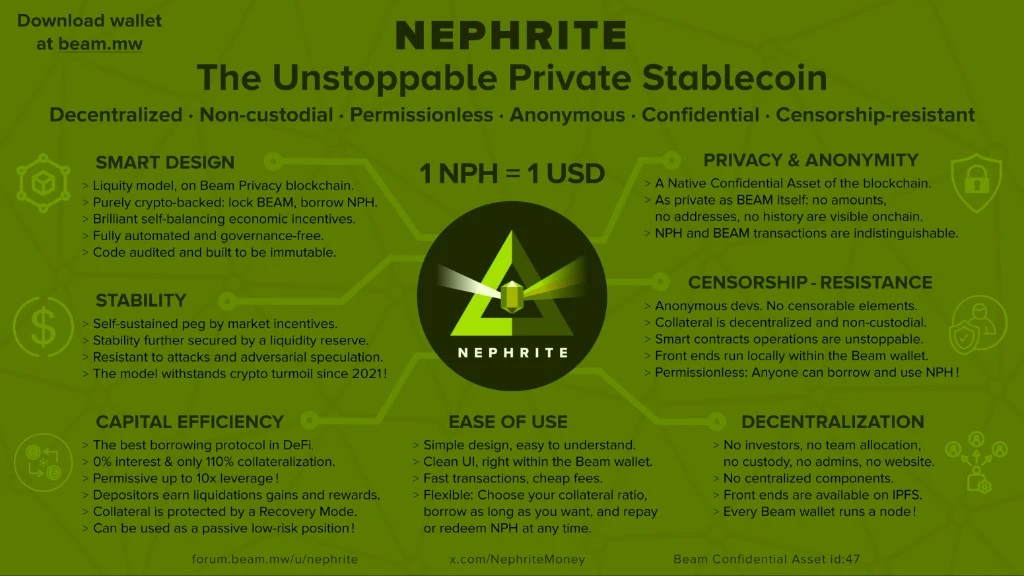
Graphic made by dbadol2000.
Its ecosystem
Nephrite operates entirely within the Beam blockchain ecosystem. Beam uses privacy features that make all transactions confidential without extra steps. Users interact with Nephrite through a dApp that runs directly in the Beam wallet. The front end is a simple web UI bundled for the wallet and run locally there; builds are also available on IPFS (the Interplanetary File System). That differs from much of DeFi, where contracts are decentralized but the interface usually lives on a normal website that can be monitored or pulled down. The system includes positions called troves, a stability pool for liquidity, and tools for liquidations and redemptions.
It connects to the Beam decentralized exchange (DEX) where people can trade NPH. The BeamX DAO ran a roughly two-year campaign that allocated BEAMX rewards to stability-pool depositors (and related liquidity incentives) to bootstrap the system; that campaign has ended. As of late 2025, NPH serves as one of the main stablecoins used inside Beam, alongside bridged versions of other coins like USDT.
DeFi on Nephrite
Yes, Nephrite provides decentralized finance, or DeFi, features. DeFi lets people lend, borrow, and earn without banks or middlemen. Users open troves by locking BEAM as collateral to mint NPH. They can adjust these positions or close them by repaying NPH. The stability pool lets users deposit NPH to earn rewards from liquidations. Anyone can trigger liquidations on risky positions and receive a small fee. Users can also redeem NPH directly for BEAM at face value using an oracle price feed. An oracle is a system that provides real-world data, such as current prices, to the blockchain. All of this happens privately on Beam.
How troves work
To create NPH tokens, you open a digital vault called a Trove (also called a Collateralized Debt Position). You deposit BEAM cryptocurrency as collateral. The protocol only accepts BEAM; it is a single-collateral system. Once your BEAM is locked, you can mint new NPH stablecoins against that value.
The system requires a Minimum Collateral Ratio (MCR) of 110 percent. For every 100 dollars worth of NPH you create, you must hold at least 110 dollars worth of BEAM in your Trove. Think of it like a home equity loan. You pledge a 300,000 dollar house to borrow 100,000 dollars in cash. In Nephrite, BEAM is the house, the smart contract is the bank, and the minted NPH is the cash.
Because BEAM's price can move quickly, the developers recommend keeping your collateral ratio at 200 percent or higher. This buffer protects you from sudden market drops that could trigger liquidation.
Dual oracle system
To calculate collateral ratios accurately, Nephrite reads BEAM/USD from on-chain oracle logic on Beam (the BeamX Network Oracle path), which updates a median-style price using several external sources. The contracts can take two oracle feeds, but only one is connected today; the second slot is not configured yet.
Liquidations and recovery mode
If a Trove drops below 110 percent collateral ratio, the system forcefully closes it. The smart contract seizes the BEAM collateral and uses it to absorb the NPH debt. Nephrite improves on older systems by using a strict order liquidation queue. The protocol always liquidates the single weakest Trove first, then moves upward. This prevents liquidators from cherry-picking only large, profitable vaults and leaving smaller risky ones behind.
The Stability Pool provides the NPH needed to execute these liquidations. When you deposit NPH into the Stability Pool, you earn the right to receive liquidated BEAM collateral. Because liquidations happen just below 110 percent, you generally receive slightly more value in BEAM than the NPH that was burned from your deposit.
If a market crash threatens the whole system, Recovery Mode activates. This happens when the Total Collateral Ratio of all Troves falls below 150 percent. During Recovery Mode, all withdrawals from the Stability Pool freeze. This prevents panic withdrawals during crashes and ensures the funds needed to save the system stay available. Withdrawals resume automatically once the system ratio climbs back above 150 percent.
Yield farming integration
While Nephrite has no governance token, it connects to the BeamX DAO that governs the broader Beam ecosystem. In March 2023, the DAO voted to allocate 6,000,000 BEAMX tokens (6 percent of total supply) to reward users who deposit NPH into the Stability Pool. Those rewards were scheduled over 24 months and that campaign has finished. BEAMX has a fixed maximum supply of 100,000,000 tokens.
You can also provide liquidity to Automated Market Maker (AMM) pools like BEAM/NPH on the Beam DEX. By depositing equal dollar values of NPH and BEAM, you receive LP tokens that earn trading fees. The BeamX DAO also ran programs that rewarded users who locked LP tokens for longer periods; check current DAO rules for anything still active.
Nephrite as an investment option
NPH is designed to track one US dollar. Because the supply grows only when users open new troves, there is no fixed total amount. Market capitalization figures often show as zero or very low due to the way the token is issued on demand rather than pre-mined.
People participate by opening troves to borrow NPH against BEAM, or by depositing NPH into the stability pool to share in liquidation proceeds. Trading happens on the Beam DEX. Scale is still modest relative to Ethereum stablecoins, and TVL changes whenever BEAM price and trove activity move; use Nephrite's own posts or on-chain views if you need a current number. All activity carries the usual risks of crypto, including price changes in BEAM collateral and potential liquidations if the collateral value drops too low.
Key risks
The main risk is exposure to liquidation events. If the market crashes and Troves liquidate, the protocol exchanges your stable NPH for volatile BEAM collateral. You must be comfortable holding BEAM as part of this process. Additionally, if the Total Collateral Ratio drops below 150 percent, the system enters Recovery Mode and temporarily suspends your ability to withdraw NPH deposits until stability returns.
For AMM liquidity providers, you face "impermanent loss." This happens when the prices of your two deposited assets diverge, temporarily leaving you with less value than if you had simply held the assets in your wallet.
Upcoming news and plans
Recent public updates from the project focus on current metrics and privacy promotion rather than a long public roadmap. The best place for current information is Beam's official X account, @beamprivacy. The @NephriteMoney account isn't as active put it still posts from time to time. The broader Beam network follows its own development roadmap, which includes ongoing privacy and DeFi improvements that could support Nephrite indirectly.
A major upcoming technical change is Hard Fork 8.0, which will add Ethereum Virtual Machine (EVM) compatibility to Beam. This allows Ethereum smart contracts to run on Beam while inheriting its privacy features. For Nephrite, this could bring more liquidity and users as new applications launch on the EVM-compatible Beam chain.
Regulatory context
By March 2025, the global stablecoin market exceeded 200 billion dollars. This growth brought heavy regulation. The European Union fully implemented its Markets in Crypto-Assets (MiCA) regulation. The United States passed the GENIUS Act in July 2025, creating the first federal framework for stablecoins. International bodies like the Financial Action Task Force (FATF) also expanded scrutiny of peer-to-peer transactions and unhosted wallets.
Nephrite occupies a unique position here. Because it is decentralized, non-custodial, and immutable, there is no company to register, no bank account to audit, and no team to enforce identity checks. Regulators view privacy protocols with caution, but Nephrite's design anticipates this. It functions as autonomous code outside traditional regulatory frameworks, serving users who prioritize privacy over compliance with centralized systems.
(Honestly, it doesn't really matter... privacy-by-default makes it nearly impossible to enforce regulations.)
Steps people take to get started
Users begin by downloading the official Beam wallet from beam.mw. They create or restore a wallet and get some BEAM through a faucet app for testing. The faucet is a tool that gives out small amounts of cryptocurrency for free so users can try the system. Next, they install the Nephrite dApp by adding the publisher key from the project’s own channel: use whatever hex string Nephrite posts on X (typically in the profile bio). Do not rely on a third-party copy of that key. Before you finish the install, confirm the value in your wallet still matches what their account shows live, in case the team rotates or moves it.
Once inside the dApp, they can open a trove, deposit NPH to the stability pool, or perform other actions. The project provides a detailed how-to guide with screenshots and step-by-step instructions, last updated in May 2023 for the main version. All interactions require agreeing that the user accepts full responsibility for risks.
When opening a trove, keep your Individual Collateral Ratio (ICR) above 150% to avoid liquidation during Recovery Mode. The system requires a minimum of 110%, but higher ratios provide safety buffers against volatility.
Always verify asset IDs when making transactions. NPH is Asset ID 47. BEAMX is Asset ID 7. Checking these numbers prevents accidentally using counterfeit tokens.
Available resources
The main resources include the project's X account at @NephriteMoney for the publisher key and archived posts, and the Nephrite user on the Beam forum. The original how-to guide lives as a PDF hosted by community members. The manifesto PDF and forum post from 2022 explain the design in detail.
Install the wallet and official dApps from beam.mw only. Historical testing used a separate Beam test network; if you need test coins or a test build, follow whatever instructions Beam and Nephrite publish now rather than assuming an old hostname still resolves. BeamAssets mirrors some DEX and pool pages for the Beam community, but aggregation and pricing there can fall behind the chain, so verify anything important against the wallet or block explorer.
For technical verification, the core Beam blockchain was audited by SmartDec, a cybersecurity firm. The Nephrite application itself underwent security auditing during Phase 0 in Q3 2022 before mainnet launch.
General support for Beam wallet issues, node synchronization, and updates flows through official community channels: Telegram at t.me/BeamPrivacy and Discord (linked from the Beam website).
References
- BeamBots (Medium), "Hosting the Nephrite Manifesto: A truly Censorship-resistant Confidential Stablecoin" - https://medium.com/@BeamBots/hosting-the-nephrite-manifesto-a-truly-censorship-resistant-confidential-stablecoin-2495a3d11a61 ↩
- BeamBots (Medium), "Hosting the how-to use Nephrite guide" - https://medium.com/@BeamBots/hosting-the-how-to-use-nephrite-guide-655518e61e7e ↩
- Beam Forum, "Presenting the Nephrite Manifesto: A truly censorship-resistant confidential stablecoin" - https://forum.beam.mw/t/presenting-the-nephrite-manifesto-a-truly-censorship-resistant-confidential-stablecoin/331 ↩
- Beam Privacy (Substack), "Beam 2023 Week #15 — Accumulation" - https://beamprivacy.substack.com/p/beam-2023-week-15-accumulation ↩
- Beam (Medium), "BEAMX Yield & Liquidity Farming Guide" - https://medium.com/beam-mw/beamx-yield-liquidity-farming-guide-567cc859fb0f ↩
- BEAM, "Downloads — Confidential DeFi & Crypto" - https://www.beam.mw/downloads ↩
- BEAM, official site - https://www.beam.mw/ ↩
- Beam Documentation, "Using Confidential Assets" - https://www.beam.mw/docs/dev/confidential-assets/using-confidential-assets/ ↩
- Beam Documentation, "Mimblewimble" - https://www.beam.mw/docs/dev/beam-technology/mimblewimble/ ↩
- SmartDec, "SmartDec Has Audited Beam Blockchain" - https://blog.smartdec.net/smartdec-has-audited-beam-blockchain-661ab2313a12 ↩
- Bank for International Settlements, "Stablecoins and safe asset prices" - https://www.bis.org/publ/work1270.htm ↩
- Chainalysis, "2025 Crypto Regulatory Round-Up" - https://www.chainalysis.com/blog/2025-crypto-regulatory-round-up/ ↩
- FATF, "Targeted Report on Stablecoins and Unhosted Wallets" - https://www.fatf-gafi.org/content/dam/fatf-gafi/publications/targeted-report-on-stablecoins-and-unhosted-wallets.pdf.coredownload.inline.pdf ↩
The Aquarian Take
Nephrite is one to keep an eye on. They've been around for a minute. As Government-approved stablecoins go mainstream it's becoming incredibly important to keep tabs on projects that protect your right to financial privacy. The Financial Skynet is coming online and projects like Beam are going to be critical to preserving those rights.
FAQ
- Why is the stablecoin named Nephrite?
The name comes from nephrite jade, a mineral prized for its toughness and resistance to fracture. The creators chose it to signal that the protocol, like the stone, should withstand market crashes and external pressure without breaking.
- How does the floating issuance fee work?
The fee adjusts dynamically based on how many people are minting NPH; it rises when activity is high and drops when quiet. These fees flow to the BeamX DAO treasury, not to the Nephrite creators, removing any direct profit motive from the development team.
- Can NPH trade with other confidential assets on Beam?
Yes. As a native confidential asset, NPH can swap atomically with other Beam privacy tokens or NFTs without revealing amounts or participants. This happens through the Beam DEX or wallet transfers, not within the Nephrite dApp interface itself.
- Is this financial advice?
No. This content is general education only.