
Background: silver's exit from coinage and the pure fiat dollar
Silver's journey from constitutional money to industrial commodity spans nearly a century of deliberate government policy. The Coinage Act of 1873 removed the silver dollar from circulation, an act opponents later decried as the "Crime of '73" when miners discovered they could no longer convert bullion to coin.1 Franklin Roosevelt's administration seized civilian silver holdings in 1934 through Executive Order 6814, requiring delivery of all silver to the Mint and prohibizing private ownership above 500 troy ounces.2 The final blow came with the Coinage Act of 1965, which eliminated silver from dimes and quarters entirely and reduced the half-dollar to 40% silver content... essentially completing silver's removal from American circulating currency.3
When Richard Nixon closed the gold window on August 15, 1971, severing the dollar's last tie to metallic backing, the transformation was complete.4 Americans who wanted to protect wealth from monetary expansion had few legal options. You could own silver, which remained unrestricted. You couldn't legally own non-numismatic gold in meaningful quantities until January 1, 1975.5
Bunker and Herbert: family politics, faith, and "sound money"
Nelson "Bunker" Hunt and his younger brother William Herbert watched the nixing of the gold standard unfold with growing alarm. Their father, H.L. Hunt, had built one of America's great oil fortunes while financing anti-communist media operations including "Facts Forum" and "Life Line," radio programs that reached millions of listeners in the 1950s and 60s.6 H.L. Hunt was also a founding member of the John Birch Society, the controversial conservative organization that viewed international communism and centralized government as existential threats to American liberty.7 The sons inherited more than money. They inherited a worldview.
Bunker Hunt's motivations for accumulating silver weren't primarily speculative. Multiple sources confirm he held what family biographer Harry Hurt III described as "apocalyptic anxieties", a conviction, rooted in his fundamentalist Christian faith, that "paper money would eventually be useless during a worldwide calamity."8 As such, the brothers viewed themselves as defenders of sound money against a broken system. "For them, silver was a more secure wealth repository than bank money," according to contemporary accounts.9 They were actively involved in conservative political causes... Bunker served on the Council of the John Birch Society, and both brothers maintained their father's commitments to limited government and free markets.10 Their mentor in monetary matters, to the extent they had one, was the Austrian tradition of economics that viewed commodity money as the only true protection against government debasement.11
The gold–silver ratio and the scale of the stack
The historical gold-silver ratio of roughly 16:1 served as their guiding metric. When they began accumulating in 1973, silver traded around $2 per ounce while gold exceeded $100... meaning silver was historically undervalued at roughly a 50:1 ratio compared to its traditional parity.12 If silver was to reclaim its monetary role, the revaluation would be dramatic. If fiat collapsed, silver would preserve purchasing power when paper became worthless. Either way, the bet made sense... at least to them.
Physical metal, IMIG, and the Saudi connection
The Hunt brothers began acquiring silver immediately after Nixon's gold suspension. Between 1973 and 1979, prices rose from roughly $2 to $6 per ounce, respectable gains, but hardly the stuff of market legends. By early 1979, they held approximately 195 million ounces of physical metal, representing about one-third of all privately held silver in the world.13
The strategy wasn't merely American. The Hunts traveled extensively, pitching their thesis to wealthy investors globally. They found particularly receptive audiences in the Middle East. By 1979, they had assembled the International Metals Investment Group with Saudi partners, including, according to trial testimony, "the brother-in-law of the Saudi Arabian crown prince."14 The combined holdings of Hunts and Saudis reached 235 million ounces by year-end 1979, along with substantial futures positions.15
Why the Saudis? Oil-producing nations had watched the 1971 dollar devaluation erase the value of their dollar-denominated reserves. The dollar was no longer "as good as gold." Silver offered an alternative store of value that wasn't under American government control. From the Saudi perspective, diversifying into hard assets made sense regardless of the Hunts' motivations. From the American perspective, the prospect of oil-rich nations collaborating with billionaire conservatives to challenge dollar hegemony triggered alarm bells at Treasury and the Federal Reserve.16
Parabolic prices, industrial pain, and Tiffany's full-page ad
Between September 1979 and January 1980, the price explosion dwarfed anything before. Silver climbed from under $9 to $50.42 per ounce on January 18, 1980... a 713% increase in four months.17 The gold-silver ratio collapsed to approximately 17:1, approaching the historic monetary parity the Hunts had targeted.18 Industrial users panicked. Photographic film manufacturer Ilford laid off workers. Tiffany & Co. took the extraordinary step of purchasing a full-page advertisement in The New York Times on March 26, 1980, condemning the "unconscionable" hoarding that "drive[s] the price up so high that others must pay artificially high prices for articles made of silver."19 The establishment had noticed. And it was preparing to respond.
Silver Rule 7, liquidation-only, and pressure from the Fed
The Commodities Exchange (COMEX) and the Commodity Futures Trading Commission (CFTC) took unprecedented action against the Hunts in early 1980. On January 7, 1980, COMEX adopted "Silver Rule 7," which imposed "heavy restrictions on the purchase of commodities on margin"... targeted specifically at leveraged silver buying.20 This was the first time in exchange history that trading rules were changed mid-game specifically to counteract specific market participants rather than system-wide volatility.
The decisive blow came approximately January 21, 1980, when both the Chicago Board of Trade and COMEX limited silver futures trading to "liquidation only."21 No new long positions could be opened. Selling was permitted. Buying was banned. Herbert Hunt later testified before Congress that "there were members of the Comex board who did have a vested interest in seeing that the price of silver went down."22
The Federal Reserve coordinated with these exchange actions, pressuring banks to "curb speculative lending" to silver buyers.23 The pieces were in place: no buyers at the exchanges, no financing from banks, and industrial users screaming for relief. The market had been rigged to crash.
Silver Thursday
On March 27, 1980, "Silver Thursday", the Hunts missed a margin call estimated at $100 million.24 Their brokerage, Bache Halsey Stuart Shields Inc., effectively collapsed. Silver prices that had opened near $21 plummeted to around $10 by afternoon.25 The brothers, who had been worth over $5 billion combined, saw that wealth evaporate overnight.26
"They changed the rules in the fourth quarter"
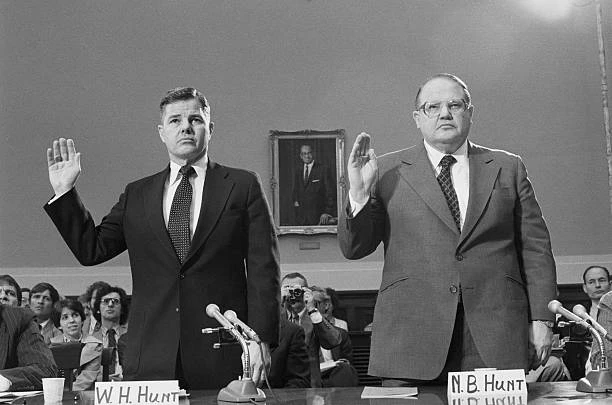
Bunker Hunt's response revealed his worldview. He referred to himself as "a favorite whipping boy" of what he termed "an eastern financial establishment riddled with liberals and socialists."27 The brothers, Herbert said, were conservative; the establishment was not. The rules had been changed specifically to destroy them. Herbert Hunt used a sporting metaphor in his May 2, 1980 congressional testimony: "To put it in terms of a football analogy: the game starts, the rules are changed, and finally when you get to the last quarter the referee says only the other side can have the ball."28 It was, they maintained, an "arbitrary change in the rules of the game" driven by political rather than market considerations.29
Congress, CFTC charges, Minpeco, and bankruptcy
The brothers' legal troubles lasted nearly a decade. In April 1980, they refused to appear before a House subcommittee investigating the silver crash, prompting the panel to vote 6-0 recommending contempt of Congress charges.30 The CFTC charged them in February 1985 with "manipulating and attempting to manipulate the prices of silver futures contracts and silver bullion during 1979 and 1980"... five years after the fact.31
The civil trial, Minpeco S.A. v. Hunt, lasted six months in 1988 and produced over 16,000 pages of transcript testimony.32 An August 1988 federal jury found the brothers guilty of attempting to corner the silver market, along with antitrust violations and racketeering. They were ordered to pay $134 million in damages to Minpeco S.A., a Peruvian state-owned mineral company that claimed losses from the price volatility.33 By September 1988, both Bunker and Herbert Hunt had filed for Chapter 11 bankruptcy protection to avoid posting a required $225 million appeal bond.34 Their net worth had fallen from $5 billion in 1980 to under $1 billion.35
The CFTC settlement came in 1989... nine years after Silver Thursday. Nelson Bunker Hunt paid $10 million in fines. William Herbert Hunt paid $10 million. Both were permanently banned from trading commodities futures.36 Notably, they admitted no wrongdoing.37 Nelson Bunker Hunt maintained his innocence under oath during the 1988 trial: "I never participated in any conspiracy with anybody at any time."38 The brothers had never been charged criminally, only civilly. The distinction matters. Manipulation requires intent to deceive. The Hunts claimed they were transparently buying silver because they believed in its monetary future. The jury disagreed. The brothers spent their remaining decades in relative quiet, Bunker dying in 2014 at age 88, still maintaining they had been persecuted for their politics and their commodities.39
Aftermath: COMEX, bank fines, and the silver debate that never ended
Whether you believe the Hunts were criminals or martyrs, the aftermath suggests their core thesis wasn't entirely wrong. Silver prices collapsed to under $5 by the mid-1980s and remained there for two decades. That's curious for a metal with declining above-ground stockpiles and rising industrial demand.
Precious metals analyst Ted Butler, who began investigating silver markets in 1985, spent decades documenting what he termed systematic price suppression through concentrated short positions on COMEX. Butler estimated physical silver stockpiles fell from over 10 billion ounces after World War II to approximately 1 billion ounces by 2004, yet prices remained depressed below $10.40 "After 40 years of silver price manipulation and suppression on the COMEX, the physical market has experienced a lack of production growth as well as enhanced demand brought about by too-low silver prices," Butler wrote in 2023.41
The evidence isn't merely anecdotal. In 2020, JPMorgan paid $920 million in record CFTC penalties for manipulative conduct in precious metals that spanned at least eight years, with traders going to federal prison for "spoofing"... placing fake orders to manipulate prices.42 Eight banks have paid over $1.3 billion collectively for gold and silver manipulation since 2016.43 The pattern Butler identified... large commercial banks maintaining massive short positions that cap price rallies... appears in CFTC Commitment of Traders data week after week.
If silver wasn't systematically suppressed post-1980, why would banks pay billions in fines to manipulate it? And why would physical silver supplies dwindle to fractions of historical levels while prices remained near multi-decade lows adjusted for inflation?
Assessment and legacy
In my view, the Hunt brothers weren't criminals. They were victims.
When Bunker and Herbert Hunt bought silver, they broke no laws. They spent seven years accumulating through voluntary transactions on regulated exchanges, using their own names, with full transparency. COMEX had never seen a problem with this until the price hit $50. Then suddenly it was an emergency.
The "liquidation only" rule had never existed before. Neither had Federal Reserve coordination to cut off financing for buyers while letting the shorts run free. These weren't regulatory responses. They were targeted hits on private citizens who threatened the fiat monopoly. The exchanges changed the rules mid-game not because the system was at risk, but because the Hunts were winning.
The civil verdict was a joke. "Manipulating" a market they had openly traded in for seven years? Meanwhile banks spent forty years actually manipulating prices through spoofing and phantom shorts. When JPMorgan traders got caught in 2020, they paid fines and kept their jobs. Nobody banned them from banking. Nobody bankrupted them. The Hunts got banned from trading, forced into bankruptcy, and smeared in the press for a decade. Different rules apply when you wear boots in Texas instead of suits in Manhattan.
Bunker Hunt died calling himself a "whipping boy for socialists." He was right about being a target. But it wasn't his ideology that doomed him. It was proving that private citizens could still protect wealth outside the fiat system. That had to be crushed. So it was.
The message was received. Silver has stayed under $30 for forty years despite supply deficits and industrial shortages. That's not a market. That's price management enforced by the same regulators who destroyed the Hunts.
The Aquarian Take
To me, the biggest takeaway is that the government will rig the system against you if you challenge their monopoly. I looked... and looked... but I couldn't find an answer to the question: Why didn't they just take physical possession of the silver? They traded paper on rigged exchanges. It's like honestly winning at the casino- no matter how honest you are, if you win, they'll throw you out and break your legs- which is exactly what happened to the Hunt Brothers.
To me, the lesson is that the government takes their monopoly seriously enough to bankrupt you and then ruin your name using the media to do it. For decades, into modern times, people regard them as some kind of criminals that tried to corner the silver market when the facts just don't bear that out.
I'm not one to defend billionaire oil tycoons... but I am one to defend the truth. And in this instance, the Hunt Brothers, by all accounts, seemingly were on a mission to restore sound money to the people of the world. A mission which Aquarian Metals is dedicated to supporting.
References
- Wikipedia, "Coinage Act of 1873," noting the Act eliminated the silver dollar from coins the Mint could legally issue, prompting the "Crime of '73" moniker from silver advocates who claimed Congress had acted surreptitiously. Coinage Act of 1873 (Wikipedia) ↩
- Wikipedia, "Executive Order 6814" (August 9, 1934), requiring delivery of all silver to the United States for coinage; also Encyclopedia of Money, "Silver Purchase Act of 1934," noting the prohibition on private ownership above 500 troy ounces. Executive Order 6814 (Wikipedia) ↩
- Wikipedia, "Coinage Act of 1965," noting elimination of silver from dimes and quarters, reduction of half-dollar to 40% silver; Provident Metals, "Learn About the History of the Coinage Act of 1965," describing this as "the most decisive factor in the decline of silver in American coinage." U.S. Mint: Mint history, Crime of 1873 ↩
- Federal Reserve History, "Nixon Ends Convertibility of U.S. Dollars to Gold," August 15, 1971; also Britannica, "Nixon shock." Federal Reserve History: Gold convertibility ends ↩
- Franklin Roosevelt's 1933 prohibition on gold ownership was lifted effective January 1, 1975, per Public Law 93-373. Britannica: Nixon shock ↩
- Spartacus Educational, "Haroldson L. Hunt," noting H.L. Hunt's funding of Facts Forum (1951) and Life Line radio programs; also Texas Monthly, "Daddy's Money," describing H.L. Hunt as a John Birch Society member and anti-communist activist. Spartacus Educational: Haroldson L. Hunt ↩
- Spartacus Educational, "Haroldson L. Hunt"; also John Birch Society historical records citing Nelson Bunker Hunt's Council membership. John Birch Society (Wikipedia) ↩
- Los Angeles Times obituary, Nelson Bunker Hunt, October 21, 2014: "In a 2009 interview, Hunt family biographer Harry Hurt III said Hunt bought the silver believing that apocalyptic days were coming that would make money useless." Los Angeles Times: Nelson Bunker Hunt obituary ↩
- CMI Gold & Silver, "The Wild, Wild Debt: The Hunt Brothers Silver Scam," noting "silver was a more secure wealth repository than bank money." CMI Gold & Silver: The Wild, Wild Debt ↩
- Wikipedia, "Nelson Bunker Hunt"; also SourceWatch entry quoting John Birch Society announcement: "We are pleased to announce that Nelson Bunker Hunt of Texas will again serve as a member of the Council of The John Birch Society." SourceWatch: Nelson Bunker Hunt ↩
- Libertarian Institute, "The Hunt Brothers' Silver Corner, Revisited: An Austrian Reinterpretation" (2024), arguing they "were not trying to 'break the market' for selfish gain... they were responding to a broken system in the only way open to private individuals... by holding and controlling a scarce, tangible asset." Libertarian Institute: Austrian reinterpretation ↩
- Monex, "Hunt Brothers Silver Story," noting Bunker Hunt considered silver undervalued relative to gold at the historic 16:1 ratio. Monex: Hunt Brothers silver story ↩
- Britannica, "Silver Thursday"; also APMEX Learning Center, "How the Hunt Brothers Cornered the Silver Market." Britannica: Silver Thursday ↩
- Los Angeles Times, "Hunts Guilty of Scheme to Corner Silver," August 21, 1988, describing testimony regarding "Arab sheiks" including brother-in-law of Saudi crown prince. Los Angeles Times: Hunts guilty of scheme to corner silver (1988) ↩
- GoldBroker.com, "Silver Thursday: Hunt Brothers' Attempt to Corner the Silver Market," noting combined holdings of 235 million ounces by December 31, 1979. GoldBroker: Hunt Brothers corner the silver market ↩
- Bullion Trading LLC, "How the Hunt Brothers Almost Cornered the Silver Market," noting "the involvement of Saudi investors added a geopolitical dimension that made officials even more uncomfortable." Bullion Trading LLC: Hunt Brothers silver market ↩
- Wikipedia, "Silver Thursday," citing 713% increase from $6.08 (January 1, 1979) to $49.45 (January 18, 1980). Silver Thursday (Wikipedia) ↩
- MetalMetric, "Gold-to-Silver Ratio," noting modern low of ~17:1 on January 18, 1980. MetalMetric: Gold-silver ratio ↩
- New York Times, "Tiffany Condemns Silver Hoarder," March 26, 1980; original advertisement quoted: "We think it is unconscionable for anyone to hoard several billion, yes billion, dollars worth of silver and thus drive the price up so high that others must pay artificially high prices for articles made of silver." New York Times: Tiffany condemns silver hoarder (1980) ↩
- Investopedia, "Hunt Brothers' Silver Thursday," noting COMEX adopted Silver Rule 7 on January 7, 1980, placing "heavy restrictions on the purchase of commodities on margin." Investopedia: Hunt Brothers' Silver Thursday ↩
- Monex, "Hunt Brothers Silver Story," noting "On or about January 21, the Chicago Board of Trade and COMEX decided to limit the contracts to liquidations only." Monex: Hunt Brothers silver story ↩
- Capital to Liberty Substack, "Silver Part 3," quoting Herbert Hunt's testimony: "There were members of the Comex board who did have a vested interest in seeing that the price of silver went down." Capital to Liberty: Silver part 3 ↩
- Cycles.org, "The Silver Squeeze: Lessons from the Hunt Brothers," noting Federal Reserve pressure on banks to curb speculative lending. Cycles.org: Silver squeeze ↩
- Study.com, "Silver Thursday History," noting the Hunts missed a $100 million margin call. Study.com: Silver Thursday ↩
- CMI Gold & Silver, "The Wild, Wild Debt," noting silver dropped from ~$21 to ~$10 in one day. CMI Gold & Silver: The Wild, Wild Debt ↩
- Wikipedia, "Silver Thursday," noting wealth decline from $5 billion (1980) to under $1 billion (1988). Silver Thursday (Wikipedia) ↩
- Wikipedia, "Nelson Bunker Hunt"; also Priceonomics, "How the Hunt Brothers Cornered the Silver Market," quoting Bunker Hunt as describing himself as "a favorite whipping boy" of "an eastern financial establishment riddled with liberals and socialists." Priceonomics: How the Hunt Brothers cornered the silver market ↩
- GodReports.com, "One of the richest men in the world endured bankruptcy," quoting Herbert Hunt's football analogy from May 2, 1980 testimony. GodReports: Hunt bankruptcy, testimony ↩
- GoldBroker.com, "Silver Thursday," noting Hunts denounced "an arbitrary change in the rules of the game." GoldBroker: Hunt Brothers corner the silver market ↩
- Washington Post, April 30, 1980, "Hunts Defy House Probe of Silver Crash." Washington Post: Hunts defy House probe (1980) ↩
- New York Times, "S.E.C. Settles Charges Against 2 Hunt Brothers," July 14, 1982; also Wikipedia, "Nelson Bunker Hunt," detailing February 1985 CFTC charges. New York Times: SEC settles charges against 2 Hunt brothers (1982) ↩
- Sun Sentinel, "Jury Penalizes Hunt Brothers in Silver Lawsuit," August 21, 1988, noting 16,000 pages of trial transcripts. Sun Sentinel: Jury penalizes Hunt brothers (1988) ↩
- Los Angeles Times, "Hunts Guilty of Scheme to Corner Silver," August 21, 1988, noting $134 million damages to Minpeco; also Deseret News, "3 Hunt Guilty in Plot to Corner Silver Market." Los Angeles Times: Hunts guilty of scheme to corner silver (1988) ↩
- Wikipedia, "Nelson Bunker Hunt," noting September 1988 bankruptcy filing. Nelson Bunker Hunt (Wikipedia) ↩
- Wikipedia, "Silver Thursday." Silver Thursday (Wikipedia) ↩
- New York Times, "2 Hunts Fined And Banned From Trades," December 21, 1989. New York Times: 2 Hunts fined and banned from trades (1989) ↩
- Royal Bull, "Silver Thursday: How 2 Wealthy Brothers Took Over the Silver Market," noting they admitted no wrongdoing in settlement. Royal Bull: Silver Thursday ↩
- Los Angeles Times, "Nelson Hunt Denies Plotting to Manipulate Silver Market," June 2, 1988. Los Angeles Times: Nelson Hunt denies manipulating silver (1988) ↩
- Crossing Wall Street, "RIP: Nelson Bunker Hunt," October 22, 2014, quoting his statement from 1980: "A billion dollars ain't what it used to be." Crossing Wall Street: RIP Nelson Bunker Hunt ↩
- SilverSeek, Ted Butler articles; also physical silver supply estimates from CPM Group and other industry sources. SilverSeek: Silver conspiracy ↩
- Silver Phoenix 500, Ted Butler archival quotes, 2023. Silver Phoenix 500: Ted Butler ↩
- CFTC Press Release, September 29, 2020: "CFTC Orders JPMorgan to Pay Record $920 Million for Spoofing and Manipulation." CFTC: JPMorgan enforcement (2020) ↩
- Navnoor Bawa, Substack: "Eight Banks Paid $1.3B for Silver Manipulation." Navnoor Bawa: Eight banks paid $1.3B for silver manipulation ↩
FAQ
- After 1971, why would wealthy Americans pile into silver instead of gold?
Nixon closed the gold window in August 1971, but Washington still blocked ordinary Americans from holding non-numismatic gold until January 1, 1975. Silver stayed legal to own outright. If you wanted bullion savings without begging permission, silver was the honest option the law left open, while policy makers hoarded leverage over the currency itself.
- Were the Hunts just speculators trying to get rich?
No. They were already billionaires; they did not need another jackpot. Family biographer Harry Hurt III described Bunker Hunt's "apocalyptic anxieties," a faith-shaped conviction that paper money could fail in crisis, and contemporaries recorded silver as a safer wealth repository than bank liabilities. Calling them mere speculators is the smear campaign from the same exchanges, regulators, and commentators who rewrote trading rules mid-rally to break longs who had the nerve to stack metal.
- Why did Saudi partners matter to the story?
Oil exporters held massive dollar balances after 1971 with no gold tether; silver was scarce, tangible, and outside direct U.S. political control. Pooling capital through structures like the International Metals Investment Group was rational insurance against a debasing reserve currency. Panic at Treasury and the Fed was not neutral risk management; it was hostility toward anyone, foreign or Texan, who moved savings into metal instead of recycling them forever into U.S. paper.
- What were Silver Rule 7 and "liquidation only"?
They were the kill-switch. COMEX rolled out Silver Rule 7 on January 7, 1980, slamming margin on leveraged longs. By late January, COMEX and the Chicago Board of Trade reportedly forced silver futures into liquidation-only mode: sell if you must, but no fresh bids. The Federal Reserve leaned on banks to choke credit to silver buyers. That sequence did not "discover" a fair price; it stripped buyers from the tape so the establishment could watch the Hunts drown on margin the exchanges helped engineer.
- What did courts and regulators conclude, and did the Hunts go to prison?
Never criminally charged, only hauled through civil hell after the market had already been broken. A 1988 jury in Minpeco S.A. v. Hunt piled on cornering, antitrust, and racketeering theories with nine-figure damages; both brothers filed Chapter 11. In 1989 the CFTC fined them $10 million each, banned them from futures for life, and they admitted no wrongdoing in the settlement. That is lawfare dressed as justice: bankrupt your target, then send regulators to mop up headlines. Bunker died in 2014 insisting he had been persecuted for politics and for choosing silver.
- Who actually manipulated the silver market, the Hunts or the exchanges?
Transparently buying and delivering silver is what honest savers do. COMEX and the CBOT rewrote margin, banned new longs, and coordinated with the Fed to starve credit: mid-game rule changes aimed squarely at named longs. Industrial users whined about price; clearinghouses whined about risk; but the crash came when public authorities removed buyers from the market. That is manipulation with a government letterhead, not Bunker Hunt filling a vault.
- What about Ted Butler, JPMorgan, and silver after 1980?
While silver spent decades wallowing under its 1980 peak, analysts like Ted Butler documented COMEX concentrated shorts capping rallies even as above-ground stock cratered. The establishment that buried the Hunts later admitted, through enforcement, that the big banks play dirty: JPMorgan paid $920 million in 2020 CFTC penalties for precious-metals misconduct including spoofing, and major institutions have paid north of a billion dollars combined on gold and silver cases since the mid-2010s. Slaps on the wrist for paper games, after the brothers who actually wanted metal were bankrupted for owning it.
- Is this financial advice?
No. This content is general education only.