Goldbacks
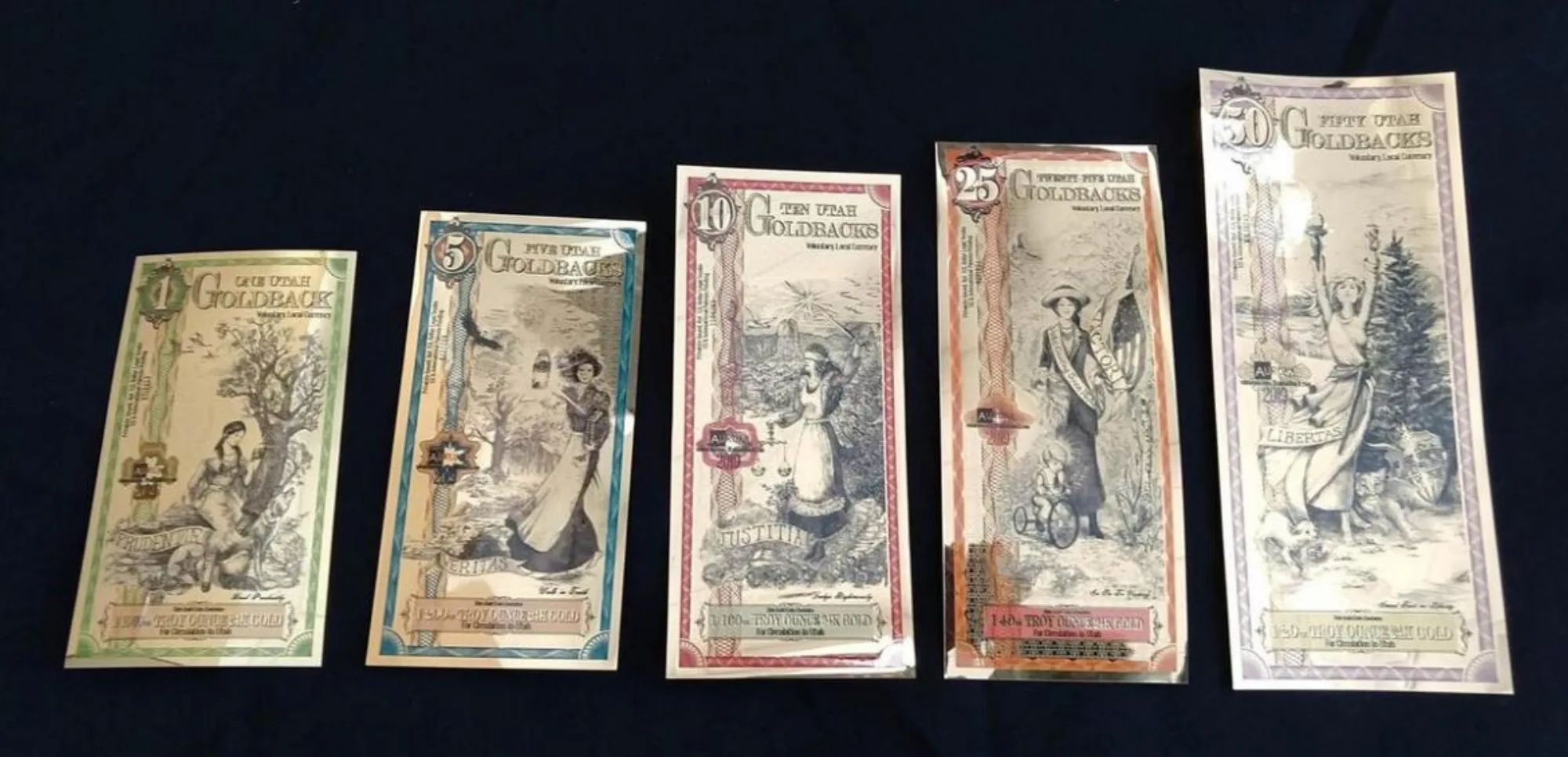
Goldbacks are thin, flexible notes that look a lot like paper money. They hold a tiny, exact amount of real 24-karat gold inside two clear polymer layers. The gold sits so thin you can bend the note without cracking it. A basic 1 Goldback contains one one-thousandth of a troy ounce of gold. Larger denominations hold more in exact proportion1 2.
The idea started in Utah. In 2011 the state passed the Specie Legal Tender Act. That law officially recognized gold and silver as legal tender within state boundaries and removed state-level tax penalties for using these metals as money. This favorable legislative environment gave entrepreneurs regulatory clearance to develop a private, voluntary gold currency without exposing users to immediate tax liabilities during daily transactions3 4. Goldback Inc., a company based in Utah, created the first Goldbacks in 2019. Founder Jeremy Cordon wanted gold in a form small enough for daily use instead of big bars or coins, combining the physical appeal of precious metals with the lightweight convenience of paper bills5 6.
Why Goldbacks Exist
Money functions on trust, utility, and consensus. For most of economic history, physical precious metals provided the baseline for global trade. Contemporary economies operate almost exclusively on fiat currency, which holds purchasing power primarily because a central government says so7. While fiat systems provide central banks flexibility to weild power and authoritarian control over economies, they carry vulnerabilities. When governments print currency, the existing money pool dilutes, resulting in the horrible inflation we now feel and experience8.
Goldbacks exist to solve a specific historical barrier known as the small coin problem. Traditional gold bullion trades in one-ounce coins or heavy bars. As the global spot price of gold rises into the thousands of dollars per ounce, a single standard gold coin becomes too valuable for routine daily purchases. You cannot easily buy groceries with a one-ounce coin, and cutting that coin into tiny fragments destroys the verifiable weight and purity9 10. By utilizing vacuum deposition technology, Goldbacks divide raw gold into exact, hyperfractional increments embedded into flexible notes, making small transactions using physical gold feasible11.
The History
Utah got the first series in 201912. Nevada followed in 2020, New Hampshire in 2021, Wyoming in 2022, South Dakota and Florida later, then Oklahoma and Arizona in 202513. Each series shows artwork tied to the state's history, culture, and landscape. A female figure called a Lady Virtue stands for a value important to the region, such as Liberty, Charity, Truth, or Prosperity. The artists surround the central figure with specific regional markers. Wyoming features pioneer history and Native American imagery. Nevada highlights gold mining heritage. New Hampshire aligns with historical emphasis on personal liberty. Florida focuses on natural ecosystems14 15.
Security features include detailed designs, serial numbers, UV-reactive ink on notes minted 2025 and later, and a raised image on the back16 17.
Engineering and Manufacturing
Creating a currency note thinner than a business card that holds verifiable gold requires specialized engineering. The manufacturing process uses vacuum deposition developed by Valaurum, a private mint18.
The production begins with durable polymer film placed inside vacuum chambers. Raw 24-karat gold is heated to extreme temperatures until it vaporizes. The resulting gold vapor condenses upon contact with the polymer. Engineers use metal masks to control exactly where the gold bonds. The layers build up atom by atom, allowing machinery to stop deposition the exact microsecond the note reaches its target weight19 20. Colored inks are applied for artwork, then a second polymer layer seals the note entirely21.
Traditional gold leaf is fragile and flakes apart easily. The polymer casing makes these notes flexible, wear-resistant, and durable enough for wallet storage without cracking the metal22.
The Ecosystem
The notes are voluntary negotiable instruments, not U.S. dollar legal tender. They function only where people choose to accept them based on the verifiable gold content23 24.
The merchant network includes over 3,500 independent businesses nationwide that accept Goldbacks for goods and services25. These range from hardware stores to organic grocers. When determining where to launch new series, Goldback Inc. evaluates community demand (requests from residents and businesses), friendly laws (states with eliminated sales taxes on gold), and strong partnerships with local coin dealers26.
A live online map and mobile app show exactly where businesses accept the notes27 28. The app includes a transaction calculator: users input the fiat price of an item, and the calculator provides the exact number of notes required based on the live daily exchange rate29. Recent updates accommodate the upcoming 1/4 note, processing payments in increments of 0.25, 0.50, and 0.7530.
Aquarian Metals Merchant Mode for Goldbacks
Accepting physical gold for coffee or whatever else means converting live rates on the spot while customers wait and the line backs up. By closing time, you are left sorting through scraps of paper or trying to remember which transaction matched which rate.
The Aquarian Metals mobile app handles that calculation and record keeping quietly. Merchant Mode shows the live rate, calculates exactly what notes to collect, and handles mixed payments or change due without mental arithmetic. Each sale logs automatically and exports to your accounting files when you need them.
Even if you never run a register, the app still functions as a portfolio tracker for precious metals. You can check live values on your Goldback holdings, track them alongside other metals, and keep unified records of your physical stack in one place on iOS or Android.
Denominations and Mathematics
Each denomination correlates to a precise fraction of a troy ounce (approximately 31.1 grams). The system is fungible: individual units are mutually interchangeable. One thousand 1-denomination notes equal exactly one troy ounce of gold31 32.
| Denomination | Gold Content (Troy Ounce) | Equivalent in 1-Notes |
|---|---|---|
| 1/4 Note | 1/4,000 | 0.25 (launching 2026) |
| 1/2 Note | 1/2,000 | 0.5 |
| 1 Note | 1/1,000 | 1 |
| 2 Note | 1/500 | 2 |
| 3 Note | 3/1,000 | 3 (limited series) |
| 5 Note | 1/200 | 5 |
| 10 Note | 1/100 | 10 |
| 25 Note | 1/40 | 25 |
| 50 Note | 1/20 | 50 |
| 100 Note | 1/10 | 100 (discontinued after Idaho series) |
The quarter note contains exactly 1/4,000th of a troy ounce and launches with the Idaho series in March 2026, followed by Florida, Oklahoma, and Arizona later that year33. This micro-denomination addresses rising gold prices that made even the smallest 1 note too valuable for minor purchases.
Conversely, the 100 denomination (containing 1/10th ounce) is being retired after the Idaho series. When gold crossed $5,400 per ounce, the 100 note exceeded $1,000 in value, creating friction for everyday shopping. Discontinuing it reduces the cost of acquiring a complete regional series by roughly fifty percent. Existing 100 notes remain valid, and the Lady Virtue design from the 100 note will transition to the 50 denomination in future printings34 35.
2026 Roadmap and Expansion
The year 2026 marks significant expansion. Following 2025 releases in Oklahoma and Arizona, Idaho launches in March with the quarter note36. Colorado becomes the tenth state, reaching one-fifth of the country37. California begins a Phase One limited rollout with fewer denominations to establish a foothold before full expansion38.
The original Utah and Nevada series receive Generation 2 visual refreshes, integrating new UV-reactive security ink and harmonizing older artwork with current production standards39.
The Washington D.C. Commemorative
To coincide with the 250th anniversary of the United States (the Semiquincentennial), Goldback Inc. announced a special Washington D.C. edition limited to 250,000 units. This single-issue commemorative features Columbia, the historic female personification of America, wearing a classical freedom cap and holding a sword and Union shield with thirteen stars. The Capitol building appears in the background40 41.
The D.C. note tests new production standards with cleaner typeface, higher-resolution printing, and a refreshed official logo. It is positioned primarily as a numismatic collectible, though it remains valid for barter within the merchant network42.
As Investments and Leasing
Goldbacks carry premiums above spot price due to manufacturing costs, artistry, and security features. This premium is retained when spent within the merchant network at the published daily exchange rate43.
The United Precious Metals Association, in partnership with Alpine Gold Exchange, offers a leasing program. Investors can lend physical Goldbacks to qualified lessees and earn 2.0% to 3.0% APR depending on volume. The minimum deposit is 10 notes. Interest pays monthly in additional physical Goldbacks, increasing metal holdings without injecting new fiat capital44.
Lease terms are open-ended until the user withdraws assets, which requires 60 days notice. Early termination may trigger a penalty fee up to 5%. Assets remain insured during storage, and vaulting fees are waived for leased amounts45.
A TrueLink Visa Debit card links to accounts, carrying a $10 monthly fee waived for balances over 1,000 notes. Wire transfers cost $15 (incoming), $30 (domestic outgoing), or $50 (international outgoing)46.
Verification and the Goldback Safe
To prevent counterfeiting, the company maintains the Goldback Safe, a digital archive containing high-resolution imagery and specifications for every note minted since 2019. Users can compare physical notes against official images to verify artwork details and anti-counterfeiting patterns. The database publishes transparent mintage numbers (for example, exactly 344,486 Nevada 1-notes were produced in 2021)47 48.
Getting Started
To begin, visit goldback.com to review exchange rates and find authorized sellers. Buy only from listed distributors to avoid counterfeits. Check the daily rate before trading. Download the free Goldback app to find accepting merchants and calculate exact change49 50.
Start with lower denominations to get comfortable handling them. Verify notes by checking serial numbers, UV features (if applicable), and the raised back image. The Goldback Safe tool helps with authentication51. Many keep notes in protective sleeves or standard wallets.
If you reside outside states with dedicated series, Goldbacks still function under standard barter law where both parties agree on value52.
Resources
Goldback.com: Full details on every series and mintage; daily exchange rates; news.
The Goldback Safe: Digital archive for verification and mintage data.
Merchant map and Goldback app: Real-time locations of accepting businesses worldwide.
Educational content: Economics Explored EP183 with Jeremy Cordon, Y'all Street EP18 with Jeremy Cordon, How Do Goldbacks Work? on Goldback.com, and r/Goldback.
Leasing programs: Available through UPMA and Alpine Gold Exchange.
References
- Wikipedia entry on Goldback. https://en.wikipedia.org/wiki/Goldback ↩
- Goldback Inc. product details. https://www.goldback.com/ ↩
- Utah Legal Tender Act (2011). https://le.utah.gov/xcode/Title59/Chapter1/C59-1-P15_1800010118000101.pdf ↩
- What Are Goldbacks? - Brady Mesch Design. https://bradymesch.com/blogs/news/what-are-goldbacks ↩
- The Org. "Jeremy Cordon, Co-Founder & President at Goldback." https://theorg.com/org/goldback/org-chart/jeremy-cordon ↩
- American Hartford Gold. "What Are Goldbacks." https://www.americanhartfordgold.com/what-are-goldbacks/ ↩
- Goldback Inc. "How Do Goldbacks Work? A Beginner's Guide." https://www.goldback.com/how-do-goldbacks-work-a-beginners-guide/ ↩
- Bullion Exchanges. "2026 Goldbacks: New State Releases." https://bullionexchanges.com/blog/2026-goldbacks-new-state-releases-and-expanding-denominations ↩
- APMEX. "What are Goldbacks?" https://learn.apmex.com/learning-guide/coin-collecting/what-are-gold-backs/ ↩
- AU Bullion Canada. "History of Goldbacks." https://aubullion.ca/history-of-goldbacks-a-new-form-of-gold-money/ ↩
- APMEX. "Which States Have Goldbacks?" https://learn.apmex.com/answers/which-states-have-goldbacks/ ↩
- Goldback Inc. "Looking Ahead: What's Coming in 2026!" https://www.goldback.com/looking-ahead-whats-coming-in-2026/ ↩
- APMEX. "Are Goldbacks Legal Tender?" https://learn.apmex.com/investing-guide/gold/are-goldbacks-legal-tender/ ↩
- Goldback Inc. "Where Do Goldbacks Circulate?" https://www.goldback.com/where-are-goldbacks/ ↩
- Goldback Inc. FAQ. https://www.goldback.com/frequently-asked-questions/ ↩
- Goldback Inc. "UV Authenticator Penlight." https://www.goldback.com/introducing-the-uv-authenticator-penlight-verify-goldbacks-in-seconds/ ↩
- Valaurum.com "About Aurum." https://valaurum.com/pages/about-aurum ↩
- Hero Bullion. "History of Utah Goldbacks." https://www.herobullion.com/history-of-utah-goldbacks/ ↩
- Y'all Street Podcast. "Ep 18: Jeremy Cordon." https://www.yallstreet.com/videos/ep-18-jeremy-cordon-goldback/ ↩
- Summit Metals. "Goldbacks: Pure Gold or Fool's Gold?" https://summitmetals.com/blogs/bald-guy-money-articles/goldbacks-pure-gold-or-fools-gold ↩
- CanAm Bullion. "What Is a Goldback." https://canambullion.com/what-is-a-goldback-and-which-states-accept-them/ ↩
- JM Bullion. "1 Washington D.C. Goldback Note." https://www.jmbullion.com/1-washington-dc-goldback-gold-note-100-pack/ ↩
- Summit Metals. "Should You Buy Goldbacks?" https://summitmetals.com/blogs/bald-guy-money-articles/should-you-buy-goldbacks-a-buyers-guide-to-gold-backed-currency ↩
- Goldback Inc. "GILD Community Corner." https://www.goldback.com/gild-community-corner-the-goldback-merchant-network-has-grown-75-this-year/ ↩
- Goldback Inc. "Pay with Goldbacks." https://www.goldback.com/pay-with-goldbacks/ ↩
- Goldback Inc. Merchant Map. https://www.goldback.com/the-merchant-map-find-businesses-that-accept-goldbacks-anywhere-in-the-world/ ↩
- Goldback Inc. App. https://www.goldback.com/goldback-app/ ↩
- iOS App Store. "Goldback." https://apps.apple.com/ae/app/goldback/id6739783504 ↩
- Google Play. "Goldback." https://play.google.com/store/apps/details?id=com.goldback.GBMobileAppCalculator ↩
- Wikipedia. "Goldback" (denominations). https://en.wikipedia.org/wiki/Goldback ↩
- Summit Metals. "What's a Goldback Really Worth?" https://summitmetals.com/blogs/bald-guy-money-articles/whats-a-goldback-really-worth-your-guide-to-exchange-rates ↩
- Hero Bullion. "1/4 Goldbacks Are Coming in 2026." https://www.herobullion.com/1-4-goldbacks-news-2026/ ↩
- Bullion Hunters. "100 Goldback Discontinued." https://bullionhunters.com/blog/2026/4/100-goldback-ends-what-it-means-for-gold-investors.html ↩
- Goldback Inc. "100 Goldback is Officially Discontinued." https://www.goldback.com/100-goldback-is-officially-discontinued/ ↩
- Bullion Exchanges. "Arizona Goldbacks Launch; Idaho Debuts Early 2026." https://bullionexchanges.com/blog/arizona-goldbacks-launch-november-18-2025-idaho-next-in-2026 ↩
- Hero Bullion. "Colorado Goldbacks Announced." https://www.herobullion.com/colorado-goldbacks-announced-guide/ ↩
- Goldback Inc. "Surprise! Another New State Series is Launching in 2026!" https://www.goldback.com/surprise-another-new-state-series-is-launching-in-2026/ ↩
- Bullion Exchanges. "Goldback Notes Evolve." https://bullionexchanges.com/blog/goldback-notes-evolve-utah-nevada-new-hampshire-retiring-as-oklahoma-debuts ↩
- APMEX. "1 Washington D.C. Goldback (100 Pack)." https://www.apmex.com/product/325172/1-washington-d-c-goldback-gold-note-24k-100-pack ↩
- Peermetals. "2026 Washington DC Goldbacks." https://peermetals.com/listings/a11ed473-0f06-4229-be91-9e8db6b5825a ↩
- eBay. "2026 Washington DC Limited Edition 1 Goldback." https://www.ebay.com/itm/168070887868 ↩
- Reddit r/Goldback. Various user discussions. https://www.reddit.com/r/Goldback/ ↩
- UPMA.org. "Pricing and Fee Details." https://upma.org/fee-details ↩
- Alpine Gold Exchange. "How to Initiate a Gold or Goldback Lease." https://alpinegold.com/blogs/resources/how-to-initiate-a-gold-or-goldback-lease ↩
- UPMA.org. Resources and FAQs. https://upma.org/resources ↩
- Goldback Inc. "The Goldback Safe." https://www.goldback.com/the-goldback-safe/ ↩
- Goldback Inc. "Goldback Safe: Authentication Tool." https://www.goldback.com/the-goldback-safe-a-powerful-tool-for-authentication-mintage-and-artwork/ ↩
- Goldback Inc. "Where to Buy." https://www.goldback.com/where-to-exchange/ ↩
- Goldback Inc. Exchange Rates. https://www.goldback.com/exchange-rates/ ↩
- Goldback Inc. "Goldback Safe Verification." https://www.goldback.com/the-goldback-safe/ ↩
- CanAm Bullion. "Where to Buy Goldbacks." https://canambullion.com/where-to-buy-goldbacks-in-2026-official-dealer-guide/ ↩
FAQ
- Can I use Goldbacks if I do not live in a state with a series?
Yes. While certain states have dedicated series with localized artwork, Goldbacks function anywhere people agree to accept them. The notes trade purely on their gold content, not the state printed on the front. Merchants outside series states can accept them based on the published exchange rate, and you can barter with individuals under standard private contract law. The app and merchant map include businesses across all fifty states.
- Can Goldbacks be damaged by water or heat?
The polymer layers make Goldbacks highly resistant to water damage. You can accidentally wash them in a pocket or spill liquid on them without destroying the gold content. However, extreme heat poses a risk. Temperatures above 300 degrees Fahrenheit can warp or melt the polymer casing, potentially compromising the note. Store them as you would standard paper currency: cool, dry places away from direct sunlight, radiators, or vehicle dashboards on hot days.
- What happens to my Goldbacks if Goldback Inc. stops operating?
Your notes remain physical gold. They do not expire or become worthless if the company closes. The gold content is intrinsic and verifiable. The merchant network might shrink without company support, but individual businesses and collectors could continue accepting them based on the metal content alone. The Goldback Safe database provides verification images independent of daily operations. However, the daily exchange rate publication and app support would cease, requiring users to calculate value based on spot prices manually.
- How do Goldbacks differ from digital gold or cryptocurrencies?
Goldbacks are physical objects you hold in your hand, not digital entries on a blockchain or in a bank account. They require no internet, electricity, or passwords to spend. Unlike cryptocurrencies, they cannot be hacked or erased by computer failure. Unlike digital gold certificates, you possess the actual metal yourself rather than relying on a vault's promise. The tradeoff is physical storage space and the risk of loss or theft that comes with carrying cash, versus the convenience of digital transfer.
- Is this financial advice?
No. This content is general education only.