
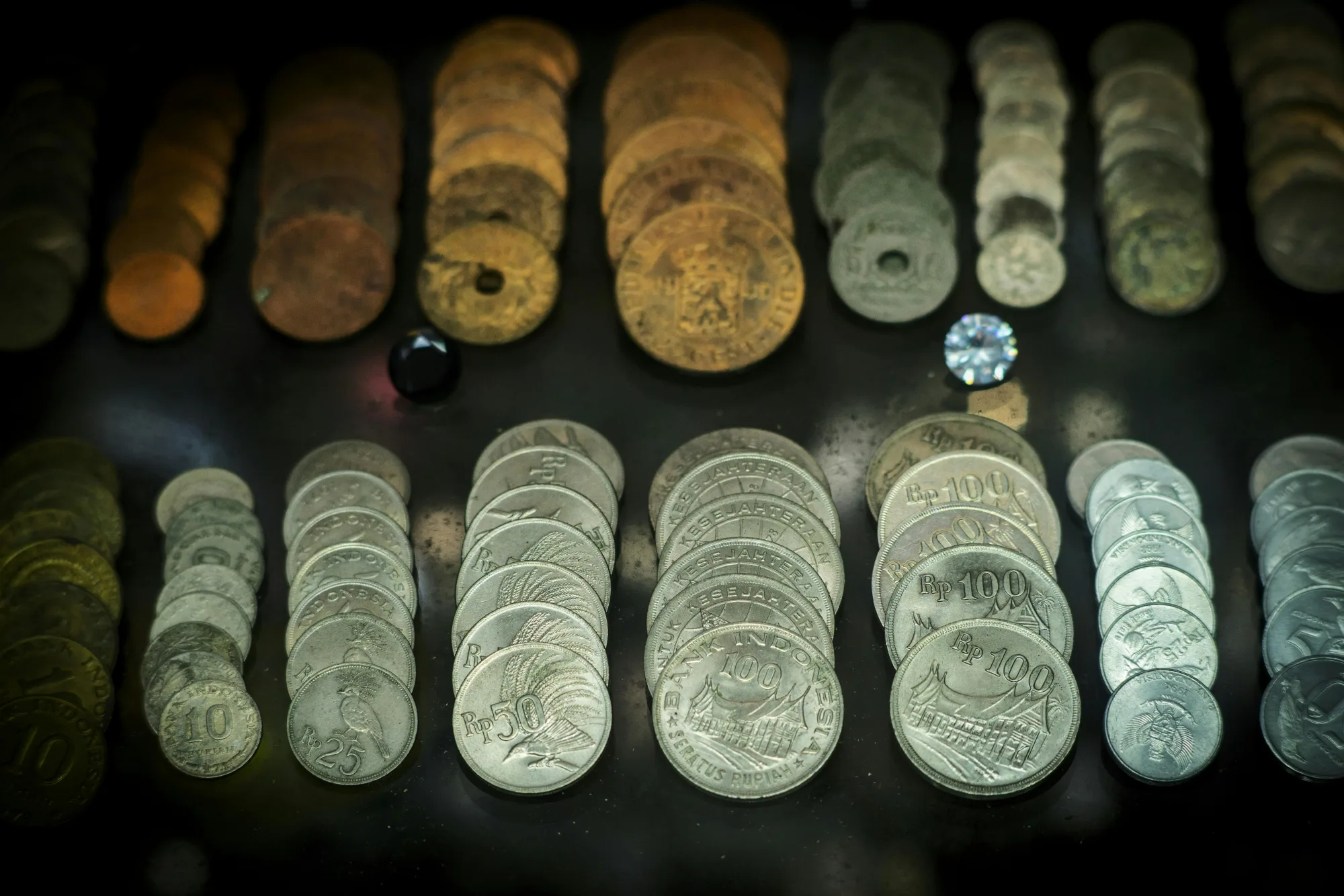
So... this is actually a pretty deep dive into numismatics. We even provide math equations for those who care about that sort of thing. If not... feel free to skip over those sections.
Starting Your Collection: The Kitchen Table Method
Collecting numismatics usually means completing a set. Not always. Some people collect individual coins because of their rarity or historical significance. But most people collect numismatics to complete a set. It's up to you how you want to approach it.
To start, you pick a boundary, which is a specific series or a date range for a specific mint, and then you hunt for what's missing. Most beginners fail because they buy cool-looking coins at random and end up with a pile of disconnected coins that may or may not have any real financial value (sentimental value counts... but it's likely you won't get much for it if you sell). Before you spend five dollars on your first purchase, decide exactly what you are trying to accomplish. That decision determines everything else.
You can start cheap, with circulating coins already in your pocket. You know the denominations (quarter, dime, nickel, penny). Now look closer at the other two facts stamped on every coin: the date and the mint mark. The date tells you when the piece was struck. The mint mark, a small letter hiding near the date or on the reverse, tells you where. P means Philadelphia, D means Denver, S means San Francisco. Philadelphia coins often carry no mark at all, which confuses beginners who assume every coin should display its origin. Denver did not exist before 1906; San Francisco started in 1854; New Orleans (O), Carson City (CC), and West Point (W) operated only during specific historical windows. Finding an O or CC on an old coin immediately signals rarity because those mints produced far fewer pieces than the big eastern factories.
This geography matters because scarcity, not age alone, drives value. Consider the 1916 Mercury dime. The Denver Mint produced only 264,000 pieces that year before the dies cracked and production stopped. Philadelphia made 22.1 million dimes that same year. Both coins look nearly identical except for a tiny D beneath the date on the Denver version. That single letter currently represents the difference between a twenty-dollar coin and a two-hundred-dollar coin. You cannot spot this detail, or the subtle wear patterns that separate grades, without magnification. A 10x jeweler's loupe (folding magnifier with a glass lens, not plastic) costs roughly fifteen dollars depending on the quality. It reveals everything your naked eye misses: hairline scratches from old cleaning jobs, weak strikes versus actual wear, and the sharpness of mint luster.
Learn to read what the loupe shows you. The flat areas behind the portrait are called fields; examine them for tiny parallel scratches that indicate someone scrubbed the coin with toothpaste or baking soda to make it shiny, permanently destroying its value to serious collectors. Check the high points, the cheekbones on Liberty's face or the feathers in headdresses, for flattening. Actual circulation wear shows as grey, flat spots where metal has physically rubbed away. Distinguish this from a weak strike, which happens when the mint press did not push hard enough or the die was already deteriorating. Weak strikes look soft and mushy, but they still retain original mint luster in the protected areas between the raised design. Worn coins do not.
Once you can confidently identify dates, mints, and strike characteristics, you face the market. This is where beginners hemorrhage money. Skip the "unsearched rolls" sold on auction sites; they have been picked over by professionals and contain only common dates, damaged goods, or worse. China currently manufactures Morgan dollar replicas that weigh correctly but use brass cores with silver plating. Test suspect pieces with a strong magnet; silver is diamagnetic, meaning it actually moves slightly away from the magnet rather than sticking. Inspect the edge reeding, the grooves around the rim created by the collar die. Genuine United States Mint reeding is sharp, uniform, and mathematically precise; cast fakes show rounded, irregular, bumpy grooves.
Finally, understand pricing mechanics before you hand over cash. The Red Book lists retail prices, what collectors realistically pay in active markets. The Blue Book and the weekly Greysheet list wholesale bid prices, the actual cash amount dealers will pay to acquire inventory. The spread between these figures often exceeds twenty percent for common material and fifty percent for rarities. Never pay full Red Book retail for a raw, uncertified coin from a dealer; if the piece genuinely merited that grade, the seller would have spent the certification fee to slab it and capture the premium.
Establish these identification skills and price anchors first. Without them, the auction terminology, scientific analysis, and market mechanics described in the rest of this guide remain abstract theory; you cannot connect technical metallurgical data or die-estimation mathematics to the physical objects actually sitting in your hand.
The Science, History, and Market Mechanics of Numismatics
Here's where the deep dive begins...
Numismatics isn't just coin collecting. It sits at the intersection of archaeology, metallurgy, economic history, and alternative asset investment. Coins are durable data. They outlast burning archives and fallen empires. Their metal content, artwork, and dispersal patterns provide unfiltered evidence of past fiscal policy, technology, and political authority.1 Today the field demands rigorous science for authentication while running a liquid, multi-billion-dollar secondary market built on subjective grading and tax strategy.2
The Evolution of Standard Exchange
Money did not arrive fully formed. It emerged gradually as a refinement of social technology.3
Early societies traded goods directly. Barter works only when both parties want what the other holds, so communities eventually settled on universally desired intermediaries. Precious metals won by default: they last, they divide, and people want them.3
By 4000 BCE, Sumerians in Mesopotamia had developed mathematical systems to value metals independently.3 They considered these materials sacred. Gold belonged to the sun god; silver to the moon god.3 The Sumerians set the gold-to-silver exchange ratio at 1:13, derived from actual astronomical observation of solar and lunar cycles.3 Transactions still required weighing metal fragments on handheld scales. Priests acted as economic arbiters, managing precious metals before temples and resolving commercial disputes, thereby establishing public trust.3
True coinage began when states monopolized production. During the seventh and sixth centuries BCE, the kings of Lydia (notably Croesus) started stamping metal disks with royal seals.3 This state guarantee of weight and purity eliminated scales from daily commerce. Greek city-states along the Aegean adopted the technology quickly.3 The Greeks treated coins as art, stamping silver and gold with detailed depictions of gods, creatures, and civic symbols.1 The beauty served a purpose: it broadcast cultural influence and civic identity across trade networks.1
When power shifted, so did the money. The Roman Empire (27 BCE to 476 CE) turned coinage into mass media. Emperors used the obverse for portraits and the reverse for propaganda, projecting military victories and imperial authority to the edges of the territory.1
After Rome fell, the Middle Ages (5th to 15th century CE) fractured the European monetary system. Unified imperial currency collapsed into localized minting. Feudal lords and regional monarchs seized the right to strike coins, using it to exact taxes and control local trade.1 Even standardization attempts (Charlemagne's consolidation of minting rights) eroded as weaker successors surrendered these privileges back to regional aristocrats.4
The Renaissance brought a leap in minting technology and aesthetic quality. Flourishing Italian city-states like Venice and Florence used distinct, high-quality coinage to assert economic independence.1 The era's revival of classical art influenced numismatic design, bringing back the fine portraiture and allegorical complexity last seen in antiquity.1
Academic study of these objects began long after they left circulation. The earliest known systematic collection belonged to the 15th-century poet Petrarch.4 For centuries, numismatic literature served wealthy hobbyists with simple catalogs of ducats and groschen.4 Not until 1790 did Joseph Hilarius Eckhel give the field a scientific foundation, categorizing coins by geography and chronology rather than mere metal content.4
Numismatics Within Archaeological Frameworks
In the 19th century, archaeologists used coins mainly to create typologies and seriations of material culture.5 Because coins carried dates or datable reigns, they worked perfectly as chronological markers. Archaeologists treated them as tools to categorize the broader historical periods of excavations.5
That perspective shifted in the mid-20th century with Processual Archaeology. Rather than just describing artifacts, archaeologists tried to understand the social systems that created them.5 The subsequent Post-Processual movement of the 1970s and 1980s pushed further, focusing on individual agency and global connectivity.5 During this ideological shift, numismatics was briefly sidelined as overly descriptive, useful only for providing a terminus post quem (the earliest possible date for an excavated feature).5 Specialists received coins, wrote detached reports, and returned them.5
Modern archaeology has reintegrated numismatics as a primary lens for human behavior. A coin in a building foundation provides immense chronological value. In 1962, a merchant ship was discovered in London with a worn coin of Domitian (A.D. 88-89) placed under its mast.6 Documentation revealed the coin was face up, displaying the reverse text "To the good fortune of the Emperor".6 This indicates the construction date and the specific superstitious practices of first-century Roman shipwrights.6
The spatial scatter of low-value bronze change offers granular data on human movement. At the sanctuary of Zeus at Nemea in Greece, archaeologists mapped small-denomination coins to identify which sanctuary areas saw the most foot traffic during specific eras.6 Identifying the distant mints that produced these pocket coins even allowed researchers to reconstruct where the travelers came from.6
Scientific Modalities in Numismatic Research
Modern numismatics has moved beyond cataloging. Researchers now use computational imaging and elemental analysis to extract historical data from metal surfaces. The coin is a metallic ledger that requires decryption.
Elemental Analysis and Micro-XRF
Exact metallurgical composition reveals the hidden economic realities of issuing states. X-ray fluorescence (XRF) spectrometry has become standard because it requires no destructive sampling.7 When X-rays illuminate a coin, elements within the metal emit secondary fluorescent X-rays.8 Each element produces a unique spectral fingerprint, allowing precise percentages of gold, silver, copper, and trace contaminants.8
This technology routinely exposes state-sponsored currency debasement. A major study of medieval Polish silver coins from the first Piast rulers (Boleslaus the Brave, 996-1025; Mieszko II Lambert, 1025-1034) used micro-XRF on 71 specimens at the National Museum in Krakow.7 Analysis detected silver concentrations ranging from 81.6% to 97.5%, with trace lead, iron, nickel, zinc, gold, mercury, and bismuth.7 This variance, particularly in Boleslaus's coins, provides metallurgical evidence of debasement suggesting severe fiscal pressure.7
XRF has physical limits. Beam penetration reaches only 10 to 100 micrometers depending on energy and metal density.9 Historical coins suffer corrosion. The natural environment leaches base metals (like copper) from surfaces, leaving artificially enriched silver or gold layers.7 XRF often reads the corroded surface rather than the true bulk alloy, sometimes creating discrepancies of up to 50% between leached surfaces and the non-corroded core.9
Reflectance Transformation Imaging
Ancient coins often emerge heavily worn, encrusted in patina, nearly illegible. Archaeologists use Reflectance Transformation Imaging (RTI) to solve this.10 RTI is computational photography that calculates light positions to allow interactive relighting of an object in virtual space.11
The process places the coin beneath a hemispherical dome. One standard dome has a 50-centimeter radius with 45 LED lights in a geodesic pattern.12 A high-resolution camera (like a Nikon D850 with 105mm macro lens) captures images while lights trigger individually from different angles.10 Software compiles these 45 images into a single file using Polynomial Texture Mapping.10
Reviewing an RTI file, a researcher drags a virtual light across the coin's surface. This dynamic shadow manipulation reveals micro-incisions, weathered characters, and subtle topology invisible under static laboratory lighting.12 The method replaces physical handling, allowing scholars worldwide to examine striking pressure and die characteristics without degrading fragile surfaces.11
RTI also tracks conservation. During treatment of heavily corroded Joseon dynasty coins, conservators used RTI to document precise patina removal and stabilization.12 After removing chloride contaminants, they immersed coins in benzotriazole dissolved in ethanol, then applied a protective Incralac coating.12 RTI provided visual documentation of surface changes before and after chemical application.12
The Mathematics of Die Estimation
Die estimation is perhaps the most mathematically intensive numismatic subfield. Ancient coins were struck by hand using engraved iron or bronze dies.13 Dies degraded and broke after limited use, so researchers can estimate total money volume if they determine how many dies were used.13
The process begins with a die study. Researchers visually compare hundreds of surviving coins from a specific issue, grouping them by the exact die used.14 Once categorized, statisticians employ formulas to estimate the "dark matter": dies that existed historically but left no surviving representatives.15
Warren Esty popularized the most reliable models.15 The mathematics relies heavily on singletons (dies represented by only one surviving coin in the sample).15 According to Esty's application of Good's estimator, the proportion of a minted population entirely missing from a modern sample approximately equals the number of singletons divided by the total sample size.15
Let n represent the total coins in the sample, d the number of different dies observed, and s the number of singleton dies.16 Sample coverage, denoted C, is:
If a researcher analyzes 204 coins and identifies 178 different dies, with 156 singletons, coverage is roughly 23.6%.16 The next coin from this issue has a 23.6% chance of belonging to a die already documented.16
To estimate the original total dies (D), statisticians previously used Carter's negative-binomial model (assuming φ=0.5).17 Esty analyzed over 600 datasets compiled by François de Callataÿ and proved most ancient coin issues follow a geometric failure-time model (where φ=1).17 Using this model:
Esty provides a mechanism for 95% confidence intervals.16 If D is the point estimate, endpoints are roughly:
Applied to 204 coins yielding 178 dies (156 singletons), the point estimate is 1088 dies.16 The 95% confidence interval stretches from 704 to 1699 dies.16 This wide interval exists because the coins-to-observed-dies ratio (n/d = 1.146) is low. A robust study requires higher ratios. A sample of 1000 coins from 330 dies yields an estimate of 416 dies with a tighter confidence interval of 392 to 440.16
Projects like the Nomisma API now automate these calculations using deep learning and SPARQL queries to aggregate coin image databases, clustering similarities to identify unique dies and running Esty's formulas dynamically.13 These figures give historians hard data on ancient state expenditures, military funding, and inflationary cycles that texts ignore.
The Dynamics of Numismatic Investment
Coins move from historical artifacts to aggressive financial vehicles only through total standardization. The numismatic market relies entirely on third-party grading to maintain liquidity and establish trust between anonymous buyers and sellers.2
The Subjectivity of the Sheldon Scale
Physical condition dictates financial value. The industry standardizes this using the Sheldon Scale, a rigid 70-point matrix.18 Grades 1 through 58 represent circulated coins bearing wear from actual commercial use.19 Poor-1 (PO-1) means barely identifiable; About Uncirculated-58 (AU-58) shows only slight friction on highest relief points.19
Real financial volatility lives in Mint State (MS) grades 60 through 70.19 These coins never entered public circulation. MS-60 pieces are technically uncirculated but often carry severe bag marks, poor strikes, or harsh toning.19 MS-70 demands absolute perfection; the Numismatic Guaranty Company (NGC) defines this as zero post-production imperfections under 5x magnification.2
Two private entities dominate certification: Professional Coin Grading Service (PCGS) and Numismatic Guaranty Company (NGC).2 Collectors submit raw coins; multiple experts review the metal before sealing it in tamper-evident, sonically welded plastic holders called slabs.2 The slab displays a barcode, certification number, and official grade.20 NGC recently attempted simplification for modern bullion collectors by introducing the NGCX scale, mimicking the 10-point comic and sports card scale where 10 equals MS-70.21
Despite clinical presentation, grading remains subjective.20 The distinction between MS-64 and MS-65 relies entirely on a human evaluator examining microscopic surface marks.20 This single point carries severe financial weight. An 1881-S Morgan Silver Dollar graded MS-64 might trade for $100. The same coin, if judged MS-65, jumps to $250.20
This delta creates a high-stakes secondary game where investors break open slabs and resubmit coins multiple times, gambling that a different grader on a different day will award a higher number.20 Grade fatigue and human bias are real.20 The market attempts mitigation through the Certified Acceptance Corporation (CAC), which reviews already-slabbed coins and affixes green or gold stickers if the coin is high-end for its assigned grade.19 A CAC sticker frequently adds 10 to 20 percent to final auction price.19
Taxation and Estate Planning
The Internal Revenue Service treats precious metals and rare coins aggressively. Unlike standard equities or real estate, the IRS classifies numismatic coins as collectibles.22 Hold a collectible less than one year and profits face taxation as ordinary income up to 37%.22 Hold longer than one year and profits face maximum 28% capital gains tax.22 High-net-worth individuals often trigger an additional 3.8% net investment income tax, pushing effective federal burden to 40.8%.22
Taxpayers cannot easily deduct losses on collectibles. The IRS strictly limits deductions unless the taxpayer proves they treated the collection as a legitimate business investment rather than a personal hobby.22 Keeping coins in a bank vault or formally lending them to a museum supports the investment argument; displaying them in a home office undermines it.22 Individual Retirement Accounts (IRAs) are strictly prohibited from holding most rare coins. If a self-directed IRA acquires a forbidden collectible, the IRS treats the acquisition cost as an immediate taxable distribution, often with a 10% early withdrawal penalty.23 The IRS only allows IRAs to hold highly specific bullion pieces, such as American Gold Eagles in pure fractions.23
Because of this punitive structure, wealthy numismatists rely on sophisticated estate planning. Coins passed directly to heirs at death receive a step-up in cost basis to fair market value at time of passing, erasing accumulated capital gains tax liability for the inheritor.22 For estates near the federal estate tax exemption limit ($13.99 million per individual in 2025), attorneys often deploy the Flip Charitable Remainder Unitrust (Flip CRUT).22 The collector transfers coins into the trust, shielding future appreciation from the taxable estate. Because coins generate no standard income, the trust pays out nothing initially. Upon a triggering event (usually the collection's sale), the trust flips to a standard CRUT and pays a fixed percentage to beneficiaries for life, before the remainder passes to designated charity.22
Stratospheric Valuations and Legendary Rarities
When rarity, demand, and historical intrigue collide, numismatic valuations shatter conventional asset metrics. The 1933 Saint-Gaudens Double Eagle represents this phenomenon's zenith.
In 1933, the United States Mint in Philadelphia struck 445,500 of these twenty-dollar gold pieces.24 Before circulation, President Franklin D. Roosevelt signed an executive order removing the U.S. from the gold standard and demanding private gold surrender.25 The Mint subsequently melted virtually the entire 1933 mintage into featureless gold bars.24
The government intentionally saved only two specimens for the National Numismatic Collection.24 However, an opportunistic Mint cashier named George McCann allegedly smuggled an estimated twenty pieces out of the facility, replacing them in accounting ledgers with older, less valuable double eagles.24 These stolen coins filtered quietly through Philadelphia jeweler Israel Switt into wealthy collectors' hands.24 Because the coins never officially issued, the U.S. Secret Service classifies them as stolen government property and actively confiscates them upon discovery.24
One specific 1933 Double Eagle evaded capture entirely. King Farouk of Egypt, an obsessive accumulator of global antiquities, purchased a specimen in 1944.24 Through a monumental bureaucratic error, the U.S. Treasury Department mistakenly granted Farouk a legal export license.24 The coin vanished following Farouk's deposition in 1952, reemerging in 1996 when British coin dealer Stephen Fenton attempted to sell it during a Secret Service sting operation at the Waldorf-Astoria Hotel in New York.24
Following years of intense litigation, the government agreed to an unprecedented settlement. The coin was moved from a World Trade Center vault just weeks before September 11, 2001, and prepared for auction.25 The government officially monetized this single specimen, charging a $20 fee to make it legal tender, and allowed sale with Fenton and the Treasury splitting proceeds.24 In 2002, the coin sold for $7.59 million to collector Stuart Weitzman.24 In a 2021 auction, the same piece commanded $18.9 million, maintaining its status as the most valuable coin ever sold.24
A similar aura of illegitimacy surrounds the 1913 Liberty Head Nickel. The U.S. Mint officially transitioned to the Indian Head "Buffalo" design in 1913; official ledgers record zero Liberty Head Nickels produced that year.25 Yet five specimens surfaced at a 1920 coin exhibition.25 Mint employees almost certainly struck them clandestinely during the midnight shift.26 Despite these illicit origins, the market treats them as royalty. One specimen sold in 2018 for $4.56 million.26
The 1804 Silver Dollar operates on an equally strange timeline. Known as the King of American Coins, the 1804 dollar was not minted in 1804.26 The U.S. State Department ordered these coins minted in the 1830s specifically as diplomatic presentation pieces for foreign dignitaries, including the King of Siam.26 Only 15 official examples exist, categorized into three distinct classes.26 Authentic specimens regularly command $3 million to $7 million at auction.26
Authentication and Archival Preservation
Extreme financial premiums guarantee endless sophisticated counterfeits. Protecting investments requires understanding materials science and archival storage.
Defeating the Counterfeit Threat
Counterfeiters aggressively target high-volume silver bullion: American Silver Eagles, Canadian Maple Leafs, British Britannias.27 Neophyte collectors can deploy several rudimentary physical tests to eliminate low-level fakes.
| Testing Methodology | Scientific Principle | Application and Limitations |
|---|---|---|
| Magnetic Attraction | Silver and gold are non-magnetic | A strong neodymium magnet will not adhere to genuine silver. However, copper or lead counterfeits also pass this test, rendering it elimination-only.27 |
| Specific Gravity | Pure silver maintains density of 10.49 g/cm³ | Weigh the coin in air, then suspended in water. Divide air weight by the difference. Accurate but tedious for large collections.27 |
| Acoustic Resonance | Silver has unique elasticity and crystalline structure | Strike a genuine silver coin balanced on a fingertip; it produces a high-pitched sustained ring lasting 1 to 2 seconds. Base metals emit a truncated thud.28 Digital applications now use Fast Fourier Transform (FFT) analysis to verify these frequencies via smartphone microphones.28 |
| Thermal Conductivity | Silver transfers heat faster than any metal | Place an ice cube directly on a silver coin; immediate rapid melting leaves the metal freezing to the touch within seconds.29 |
These manual tests suffice for standard bullion, but high-value numismatic pieces require professional, non-destructive technological verification. Advanced counterfeits now employ thick gold plating over tungsten cores. Tungsten shares almost identical specific gravity with gold (19.25 versus 19.30 g/cm³), allowing fakes to pass precise weight and dimension checks.29 To combat this, dealers use ultrasonic testing equipment sending high-frequency sound waves through metal.27 Solid gold bars return uniform acoustic echoes; tungsten cores cause immediate signal disruption at internal boundaries.29 Magnetic conductivity tests also expose tungsten fakes; sophisticated sensors map the metal's distinct reaction to magnetic fields without scratching surfaces.29
The Chemistry of Safe Storage
Securing a genuine coin is only the first step. Poor storage materials actively destroy value. The primary threat is Polyvinyl Chloride (PVC).30
Manufacturers use PVC heavily to create cheap, supple, transparent plastic flips and binder pages.31 PVC requires chemical plasticizers to remain flexible. Over time, particularly with heat and light exposure, these additives degrade and leach hydrochloric acid onto coin surfaces.30 The acid reacts with silver and copper alloys, forming sticky, corrosive green slime.30 This reaction permanently etches the metal. Coins suffering PVC damage become functionally unsellable in the certified market without professional, highly invasive conservation.30
Archival preservation demands strict avoidance of any product lacking explicit PVC-free labeling.30 Professional collectors rely on Mylar (polyester film) flips or inert hard plastic capsules.32 Even non-PVC vinyl flips present dangers; a PCGS study revealed that oils bleeding from soft plastic flips cause cloudy appearances, and embedded particles cause microscopic hairlines during insertion.33 For long-term environmental stability, collectors employ specialized albums featuring Intercept Shield technology. These integrate reactive copper particles into the cardboard matrix to neutralize atmospheric sulfur and corrosive gases before they tarnish the metal.33
Strategic Directives for the Neophyte
Entering the numismatic market blindly usually results in significant financial losses. The prevailing maxim among veteran dealers is simple: "Buy the book before the coin".34
Successful acquisition requires deep contextual knowledge of the specific series targeted.35 The foundational text for American coinage is R.S. Yeoman's A Guide Book of United States Coins, universally called the Redbook for its red cover.34 Published annually since 1947, with over 25 million copies sold, the Redbook provides exhaustive mintage figures, historical context, and relative retail pricing for every federal coin.34 It also covers colonial coinage and territorial gold.34 While dynamic market shifts render print pricing guides obsolete for high-end wholesale (for which dealers use the Blue Book or Greysheet), the Redbook establishes necessary baselines for identifying key dates and semi-key rarities.36
Equally important is the Official A.N.A. Grading Standards for United States Coins.34 An uneducated buyer cannot parse the difference between EF-40 (Extremely Fine) and AU-50 (About Uncirculated).34 Purchasing without understanding specific wear points dictated by ANA standards leaves buyers at the mercy of sellers' potentially inflated claims.34 For broader market understanding, beginners often read 100 Greatest United States Coins by Jeff Garrett and Ron Guth, which details backstories behind the hobby's most expensive items.34
The second major directive is maintaining strict collecting focus.35 The sheer volume of available material overwhelms new entrants. Collectors must define parameters early. This might mean assembling a complete date run of Morgan Silver Dollars, hoarding heavily circulated Roman denarii, tracking down obscure Civil War merchant tokens, or stacking modern Canadian Silver Maple Leafs.35 Rigid parameters, documented spreadsheets, and defined capital budgets prevent accumulation of disjointed, illiquid hoards of random metals.35
The discipline of numismatics requires practitioners to operate simultaneously as archivists, materials scientists, and aggressive financial analysts. A small silver disk struck in ancient Rome contains complex data regarding state stability, metallurgical capabilities, and labor exploitation. Extracting that data requires advanced computational imaging like RTI and the statistical rigor of die estimations. Yet once identified and verified, these same historical objects enter a ruthless secondary market ruled by microscopic grading discrepancies and complex tax codes. Navigating this space successfully demands absolute reliance on physical testing protocols, strict adherence to archival storage chemistry, and a foundational commitment to studying the literature before ever acquiring the metal.
References
FAQ
- Should I clean a dirty or tarnished coin?
Usually not. Polishing and home solvents trade short-term shine for permanent hairlines and stripped patina, and that damage is hard to undo. Collectors pay for original surfaces; what looks like “dirt” is often part of the story. If something is actively harmful or cemented on, ask a professional conservator instead of experimenting at the sink.
- What is a key date, in plain terms?
Within one design series, a key date is the year or mint mark that is scarce relative to the rest. Common dates fill albums for pocket change; keys cost more because fewer nice examples survive. Price guides flag them, but grade and eye appeal still move the number you actually pay.
- Where should a beginner shop first?
A patient local shop or a club table at a show beats anonymous impulse buys when you are still learning to read wear and photography tricks. You can compare pieces side by side and say “show me why this costs more.” Save fast online auctions for after you know how to verify returns, shipping, and the seller’s reputation.
- Is it safe to touch coins with bare fingers?
Handle high-value or proof coins by the edge, not the faces. Skin oil and moisture leave residues that can spot metal over years, especially on mirrored fields. Cotton gloves are fine for some people; many longtime collectors skip gloves but still avoid dragging a thumb across the devices.
- Do I need to insure a small collection?
Maybe. Standard homeowners coverage often caps jewelry and collectibles or pays only after a large deductible. Photograph what you own, keep receipts or screenshots, and call your agent about a scheduled rider or a standalone policy. Documentation helps even if you never file a claim.
- Is this financial advice?
No. This content is general education only.